|
Index to All Eight Articles on Mary
ON THIS PAGE
Emphasis Mine in All Bible Verses
Part I
Revelation 12:1 - A Woman Clothed With The Sun
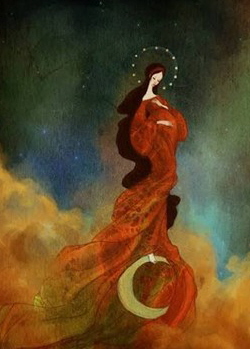
One of the texts put forth in support of Mary's lofty status bestowed on her by Rome is John's description of "a great sign" that he saw appearing in heaven - "... a woman clothed in the sun, with the moon under her feet and a crown of twelve stars on her head. Interpreting this symbolism as a reflection of her bodily assumption, Catholicism claims this woman is Mary. (See The Assumption)
The Three Options
The identity of the woman portrayed in John's account has given rise to many different opinions. Some believe the woman represents Israel, others the Church (a non-starter), However, interpreting this symbolism as a reflection of her bodily assumption, Catholicism claims this woman is Mary.
Mary - The New Ark Of The Covenant???
Because this verse is immediately followed by John's vision of a woman
Catholics take this to mean that Mary is the New Ark of the Covenant.
Section Includes
The Appearance of The Ark Of His Covenant in Context
The Timing Is Critical
A Literal Woman?
The Other Woman of Revelation
The Ensuing Circumstances
Israel
The Judean church is virtually in all respects the best candidate for identification with the woman
Part II
Other Reasons Put Forward as Evidence For Mary's Exalted Status
Solomon Pulled up A 'Throne' For His Mother and Seated His Mother On His Right
Of course, it would have been immeasurably rude for Solomon to have kept his mother standing
Why It's Not Very Wise To Use The Intercessory Role of The King's Mother
In Summary - There was Not all That Much Emphasis Placed On The Mother Of The King
Nebuchadnezzar
The Wedding at Cana
Many use the wedding in Cana as an example of Mary interceding with Jesus on behalf of a person or persons.
The Significance Of and Reason For Jesus' First Miracle. (At Least According to John)
 Does Mary's Foot Crush Satan's Head?
Revelation 12:1 - A Woman Clothed With The Sun
One of the texts put forth in support of Mary's lofty status is John's description of "a great sign" that he saw appearing in heaven. In fact, Roman Catholic art commonly depicts Mary as standing on a crescent moon with twelve stars around her head.
"... a woman clothed in the sun, with the moon under her feet and a crown of twelve stars on her head. (Revelation 12:1 BSB)
The identity of the woman portrayed in John's account has triggered a number of widely disparate opinions. Some say she represents Israel, others the Church. Rome, on the other hands is adamant that the woman represents Mary. Understood this way it can be seen to support several of Catholicism's beliefs.
1.) Because the woman is clothed with the sun, standing in the moon and crowned with stars they believe that the exalted position they hold Mary in is justified.
2.) Verse 17 makes reference to "the rest of her offspring" which is taken to mean she is the mother of all Christians
3.) Mary is equated with the "new ark of the covenant,: dues to the fact that the vision of the woman follows on the heels of the appearance of the ark in heaven (11:19)
The problem is that none of the opinions (the woman represents the Church, Mary, or Israel) are without merit, and none of them are without problems.
The Three Options
The Church
The belief that the woman is the church is usually based on the fact that she flees into the wilderness, to a place prepared by God, where she would be nourished for one thousand two hundred and sixty days. The time frame is the equivalent of three and a half years (forty-two months) the length of time the nations will tread under foot the holy city and the two witnesses will prophesy (Revelation 11:1-3).
However, this option can quickly be dispensed with, simply because the church did not give birth to Jesus. It was the other way around.
Mary - The New Ark Of The Covenant?
Part of the reason Rome claims this woman is Mary is because verse 11:19 in which God's temple in heaven was opened to reveal the "Ark of His Covenant" is immediately followed by John's vision of the woman. It has absolutely nothing to do with Mary
Then the temple of God in heaven was opened, and the ark of His covenant appeared in His temple. And there were flashes of lightning, and rumblings, and peals of thunder, and an earthquake, and a great hailstorm. And a great sign appeared in heaven: a woman clothed in the sun, with the moon under her feet and a crown of twelve stars on her head. (Revelation 11:19 - 12:1 BSB)
However, this doesn't necessarily mean that Mary is the New Ark of the Covenant simply because the book of Revelation is NOT like the chapters in a regular book ie. in chronological order.
John's vision was not set in any particular time frame, which means he could have been describing a broad panorama of Biblical history that sometimes went back and forth through the ages.
And no! Luke did not intend to tell us that Mary herself is the new Ark of the Covenant. The site marion.org states that
Just as the Ark in ancient Israel contained the tables of the Law, and some of the manna-bread from heaven - signs of the Old Covenant - so Mary's womb contained the sign of the promise of the New Covenant and the true Bread of Life: Jesus our Savior Himself. See Drawing Analogies Where There Are None
The Appearance of The Ark Of His Covenant in Context
No Bible verse or passage can be correctly interpreted apart from its context which is this case is...
(15) Then the seventh angel sounded; and there were loud voices in heaven, saying, "The kingdom of the world has become the kingdom of our Lord and of His Christ; and He will reign forever and ever." (16) And the twenty-four elders, who sit on their thrones before God, fell on their faces and worshiped God, (17) saying, 'We give You thanks, Lord God, the Almighty, the One who is and who was, because You have taken Your great power and have begun to reign.
(18) "And the nations were enraged, and Your wrath came, and the time came for the dead to be judged, and the time to reward Your bond-servants the prophets and the saints and those who fear Your name, the small and the great, and to destroy those who destroy the earth." (19) And the temple of God which is in heaven was opened; and the ark of His covenant appeared in His temple, and there were flashes of lightning and sounds and peals of thunder, and an earthquake, and a great hailstorm. (Revelation 11:15-19 NASB)
See Context is CRUCIAL
The Timing Is Critical.
The seventh trumpet has just been sounded. This last and final trumpet is the most eventful of all them all - literally ushering the old age out and the new one in.
In the Old Testament the Ark was a powerful symbol of God's presence and it is no different in the New.
The fact that the opening of the temple in heaven is accompanied by 'flashes of lightning, rumblings, peals of thunder, an earthquake, and a great hailstorm' tells us more than the Father has simply made His appearance. The severe weather and seismic activity is not only dramatic manifestation of God's power and presence but that Divine judgment is about to be rendered on this planet and its inhabitants.
It has absolutely nothing to do with Mary
See That Earth Shaking Seventh Trumpet - Part IV of The End of The Age
In a sense the Seventh Trumpet will be the most eventful of all them all literally ushering the old age out and the new one in. In summary, this last and final Trumpet... a) Shuts forever the doors to the Kingdom with no possibility of redemption for any that have not yet become a disciple of the Lamb. b) Marks the point when believers are caught up in the clouds to meet the Lord in the air - physically moved off the earth for a very specific reason, and c) Introduces the Seven Bowls that ends all things.
And
The "Rapture" - Part V of The End of The Age
The page has been confined to the reasons the Pre-Tribulation Rapture is a figment of the imagination.
A Literal Woman?
To return to the vision John was given of a woman standing on the moon wearing a crown of twelve stars.
A great sign appeared in heaven: a woman clothed with the sun, and the moon under her feet, and on her head a crown of twelve stars; (Revelation 12:1 NASB)
The next few verses go on to say...
(2) and she was with child; and she *cried out, being in labor and in pain to give birth. (3) Then another sign appeared in heaven: and behold, a great red dragon having seven heads and ten horns, and on his heads were seven diadems. (4) And his tail *swept away a third of the stars of heaven and threw them to the earth. And the dragon stood before the woman who was about to give birth, so that when she gave birth he might devour her child. (5) And she gave birth to a son, a male child, who is to rule all the nations with a rod of iron; and her child was caught up to God and to His throne. (Revelation 12:1-5 NASB)
It is obvious that the child who is "to rule all the nations with a rod of iron" is Jesus Christ the Messiah who rose from the dead, ascended into heaven ("caught up to God and to His throne" in verse 5), and who will return bodily to this earth in power and glory to crush all opposition and to "rule all the nations" from Jerusalem.
The dragon who was waiting for the woman to give birth in order to devour her child is an obvious reference to Satan in the form of Herod who, when the Magi from the east arrived in Jerusalem, asking "Where is He who has been born King of the Jews?", tried find Jesus to eliminate the competition by having Him killed (Matthew 2:1-12).
Therefore the argument made for the woman being Mary is since the other two main characters in the chapter are identified as specific individuals it seems likely that the woman, as the third major character, would not be symbolic of a group but also an individual.
This again is not necessarily true.
What we need to remember is that the verse begins with the word sign ("A great sign appeared in heaven: a woman clothed with....."), translated from the Greek semeion, which means a perceptible or visible indication of something not immediately apparent. John's vision of the woman of Revelation 12 had to be an indication of one or more events,
As Bob Utley from Bible.org says (Emphasis Added)
In apocalyptic literature the central theme of the vision is crucial, but the literalness of the presentation, the details and the images are dramatic, symbolic, fictional. It is our curiosity and respect for the Bible that motivates our detailed, logical, doctrinal formulations. Be careful of pushing the details; apocalyptic literature is often true theology presented in an imaginative frame-work. It is true, but symbolically presented! [01]
In any case there is precedent in Revelation for something other than a literal woman something or someone to be depicted as one.
The Other Woman of Revelation
The seventeenth chapter speaks of John seeing another woman who was
... sitting on a scarlet beast, full of blasphemous names, having seven heads and ten horns. The woman was clothed in purple and scarlet, and adorned with gold, precious stones, and pearls, holding in her hand a gold cup full of abominations and of the unclean things of her sexual immorality, (Revelation 17:3-4 NASB)
However, this 'woman' was not a literal woman. Her name was "Babylon the great, the mother of prostitutes and of the abominations of the earth.” She was "drunk with the blood of the saints, and with the blood of the witnesses of Jesus. (Revelation 17:5-6 NASB)
The Ensuing Circumstances
Although the fact that the woman in Revelation 12:1 gave birth to the Messiah points to Mary, the subsequent description of the woman's circumstances do not. Verse 13 says
And when the dragon saw that he was thrown down to the earth, he persecuted the woman who gave birth to the male Child. (Revelation 12:13)
Mary was last mentioned on the book of Acts. Absolutely nothing in Acts or beyond indicates that the dragon's persecution caused her flee to the wilderness. Nor is there the slightest hint that Mary actually made such a flight.
However, Jesus Christ warned his followers in the Synoptic Gospels (Matthew 24:15 - 22, Mark 13:14 - 20, Luke 21:20 - 24) to flee to the mountains and leave Jerusalem when they saw it surrounded by armies.
And so they did.
As said on the web site of the Biblical Archaeology Society
Some scholars believe that the escape of the women's offspring into the wilderness in Revelation 12:6, 14 - 17 uses mythological language to describe the flight of the Jerusalem church to Pella. While Revelation 12 is difficult to interpret, there does seem to be a historical basis for the events it describes.
The dragon's attempt to destroy the Jewish Christians, first in Zealot-controlled Jerusalem, and then while crossing the Jordan during the winter floods, came to naught. Instead, the Gentile churches of the Decapolis rescued and aided the Jewish-Christian refugees. With the Jerusalem church safe, the dragon next gave his attention to making war against the rest of the saints (12:17)...
... such a reconstruction must be taken into consideration, since others have little to commend them.
In fact
"Eusebius's Church History (3.5.3) recounts that the Jewish followers of Jesus heeded his warning and fled to Pella for safety prior to the siege of Jerusalem in AD 70" [02]
Revelation 12:17 tells us that the woman's 'other offspring' were also persecuted.
So the dragon was enraged with the woman, and went off to make war with the rest of her children, who keep the commandments of God and hold to the testimony of Jesus. (Revelation 12:17 NASB)
We do know that Mary had other children after Jesus was born but, once again, there is no mention of them being singled out and persecuted. See Mary's Perpetual Virginity
Israel:
That Mary, who gave birth to the Messiah in His human form is, at least partially, indicated by the woman cannot be denied.
However, let us not ignore the fact that the image of the sun, moon, and twelve stars around the woman's head are very definitely an allusion to Joseph's dream in Genesis 37:9-11 in which the sun and the moon and eleven stars bowed down to him. The text reads
Now he had still another dream, and related it to his brothers, and said, "Lo, I have had still another dream; and behold, the sun and the moon and eleven stars were bowing down to me." He related it to his father and to his brothers; and his father rebuked him and said to him, "What is this dream that you have had? Shall I and your mother and your brothers actually come to bow ourselves down before you to the ground?" (Genesis 37:9-10 NASB)
Although Joseph's father Jacob rebuked him he "kept in mind what he had said".
Jacob was the sun, Joseph's mother Rachel, was the moon, and his twelve sons, who became the fathers of the twelve tribes of Israel, were the stars. Thus the twelve stars in the woman's crown symbolize the twelve tribes of Israel clearly linking her to Israel.
In other words, the vision referred to Israel from whence the Messiah came, not the royalty or queenship of the woman.
A Dissenting Opinion
However, Mark Brumlev, managing editor of The Catholic Faith magazine outlines several problems with the non-Marian interpretations. One of which is that...
The Dragon, i.e., the devil, pursues the Woman after she gives birth to the Messiah. Unable to attack her, the Dragon then makes war against the Woman's other offspring. If the Woman is Israel, how is it that the Dragon pursues her and makes war against her children? These children are clearly disciples of Jesus (Rev 12:17).
Why would Israel be depicted as the Mother of Jesus' disciples, which is what would be the case if the Woman were simply Israel? Furthermore, is it likely that John would depict Israel as the Mother of the Messiah? [03]
The verse in question says,
And the dragon was enraged at the woman, and went to make war with the rest of her children, who keep the commandments of God and hold to the testimony of Jesus. And the dragon stood on the shore of the sea. (Revelation 12:17 BSB)
It is true that the New Testament never refers to Christians as the children of Mary.
On the other hand, if the woman is seen as the first century New Testament Church, the Gentile Christians "who keep the commandments of God and have the testimony of Jesus Christ,” could be easily understood as "the rest of her offspring."
Although Mary is never referred to as a "spiritual mother" ALL believers who belong to Christ are the spiritual 'sons' of Abraham the father of Israel as we are justified by faith just as he was. Our spiritual roots are clearly tied to Abraham
For this reason it is by faith, in order that it may be in accordance with grace, so that the promise will be guaranteed to all the descendants, not only to those who are of the Law, but also to those who are of the faith of Abraham, who is the father of us all, (Romans 4:16 NASB)
Even so Abraham believed God, and it was reckoned to him as righteousness. Therefore, be sure that it is those who are of faith who are sons of Abraham. (Galatians 3:6-7 NASB)
And if you belong to Christ, then you are Abraham's descendants, heirs according to promise. (Galatians 3:29 NASB)
In summary the Judean church is in virtually all respects the best candidate for identification with the woman
Part II - Other Texts Put Forward As Evidence For Mary's Exalted Status
Many Catholics endeavor to show that Mary's exalted status is justified based on a supposedly significant role played by the mothers of various kings (most often Solomon and Bathsheba) in the history of Israel. The logic being that when Christ ultimately and eternally takes His rightful place on the throne of David, Mary will have the honor of being 'Queen Mother' in God's kingdom.
Solomon and Bathsheba
There are two points in 1 Kings 2:19 that Catholics take to indicate Mary's importance. The verse reads...
So Bathsheba went to King Solomon, to speak to him for Adonijah. And the king stood to meet her, bowed to her, and sat on his throne; then he had a throne set up for the king’s mother, and she sat on his right. (1 Kings 2:19 NASB)
1.) Solomon Pulled up A 'Throne' For His Mother?
One argument used in favor of the status of the king's mother is that when Bathsheba went to King Solomon to speak to him on Adonijah's behalf, Solomon rose to meet her, bowed, then had a "throne" set on his right for her. (1 Kings 2:19).
Although the same word (kissêh) was used both for Solomon's seat and the one he had set for his mother, it does not necessarily mean that both occurrences meant a "throne". There is no doubt that the majority of uses of kissêh are used for an actual royal throne - God's throne (Isaiah 66:1), David's throne (Jeremiah 22:2) The Pharaoh's throne (Exodus 11:5), the king of Nineveh's throne (Jonah 3:6) etc.
However, kissêh also refers to a seat or stool. It is used to describe what Eli the priest was sitting on near the door of the temple and, later, by the side of the road. In both cases it obviously meant some sort of seat.
Then Hannah rose after eating and drinking in Shiloh. Now Eli the priest was sitting on the seat (Heb. kissêh) by the doorpost of the temple of the LORD. (1 Samuel 1:9 NASB)
Considering it would have been immeasurably rude for Solomon to have kept his mother standing, it stands to reason that when she walked in he had a seat of some sort pulled up so she could sit down? That he pulled up a throne for her does not make any sense. In any royal setting there is usually just the one throne - a heavy, ornate piece of furniture for the king that cannot be easily manipulated or moved.
1.) Solomon's Seated His Mother On His Right
The fact that the verse mentions that Solomon seated his mother on his right could just mean that he had great respect for her.
It takes a vast stretch of the imagination to apply this gesture to Christ and Mary ie. Christ will seat Mary on His right. In any case the Biblical evidence does not support Mary sitting at God's right hand
John's speaks of the "the throne of God", "God who sits on the throne", "the Lamb in the center of the throne", "the throne of God and of the Lamb" etc. Although John even describes a great multitude standing before the throne, he says absolutely nothing about Mary standing at the king's right hand.
After these things I looked, and behold, a great multitude which no one could count, from every nation and all tribes and peoples and tongues, standing before the throne and before the Lamb, clothed in white robes, and palm branches were in their hands; and they cry out with a loud voice, saying, 'Salvation to our God who sits on the throne, and to the Lamb.'" (Revelation 7:9-10 NASB)
"For this reason, they are before the throne of God; and they serve Him day and night in His temple; and He who sits on the throne will spread His tabernacle over them. They will hunger no longer, nor thirst anymore; nor will the sun beat down on them, nor any heat; for the Lamb in the center of the throne will be their shepherd, and will guide them to springs of the water of life; and God will wipe every tear from their eyes." (Revelation 7:15-17 NASB)
"Then he showed me a river of the water of life, clear as crystal, coming from the throne of God and of the Lamb" (Revelation 22:1 NASB)
And, as a by the way, perhaps you have noticed that the Holy Spirit was also missing from other visions of God's throne seen by Daniel, Stephen and John. In fact, the third person of a supposedly triune God is curiously absent from the left hand of the Father, all New Testament doxologies, and the opening salutation of most of the New Testament books.
See Is God a Trinity? /the_trinity.html
Note: Challenging the doctrine of the Trinity does not mean challenging the Divinity of Christ and it does not mean challenging the Divinity of the Holy Spirit. The New Testament abounds with much proof of the deity of Jesus Christ and Acts 5:3-4 is more than enough to clinch the issue of the Holy Spirit being God. However, there is absolutely no evidence that the Holy Spirit is the 'third person of the Trinity. Theologians over simplify the matter when they state that the Biblical evidence permits only one of two conclusion a) Jesus and the Holy Spirit are not Divine, or b) God is a Tri-unity. It's either this or that... take it or leave it.)
Why It's Not Very Wise To Use The Intercessory Role of The King's Mother
In an article entitled Mary Queen of Heaven - the Bible Tells Me So, Fr. Dwight Longenecker says
Mary as the Queen of Heaven is tied in with the Old Testament concept of the royal household. Because the King had many wives it was impossible for one to be Queen. Therefore the King's mother served in the role.
The Queen Mother sat on a throne at the King's right hand and helped rule the kingdom. Access to the King would often be through the Queen Mother and she would ask favors from the King for those who asked her. You can see an example of this in I Kings 2: 17-25 where Solomon is on the throne next to his mother Bathsheba. [04]
In the first place why are assuming that what humans do or not do on earth is necessarily reflected in Heaven. And why do we elaborate and expand ONE incident to mean that the king's mother had an 'intercessory role'.
In any case, using Bathsheba's supposed intercessory role as a precedent is a very bad idea.
When Adonijah David and Haggith's son (David's fourth - 2 Samuel 3:4) came to Bathsheba and asked her to she intercede with Solomon on his behalf and give him Abishag the Shunammite as a wife he not only refused her, but also had Adonijah put to death that very day (1 Kings 2:24-25).
2 Kings 24:14-15
Others place importance on the fact that, as related in the second book of Kings, Nebuchadnezzar carried the king's mother into captivity. While it stands to reason that the mother of the king would have been an important person in the kingdom, the verse says the kings entire family, including his wives, his mother (Heb. êm), the officials and leading men of the land were ALL led away into captivity.
There is NO particular emphasis on the mother of the king. In fact Nebuchadnezzar also took a bunch of other non-royals captive.
Then he led away into exile all Jerusalem and all the captains and all the mighty men of valor, ten thousand captives, and all the craftsmen and the smiths. None remained except the poorest people of the land. So he led Jehoiachin away into exile to Babylon; also the king's mother (Heb. êm) and the king's wives and his officials and the leading men of the land, he led away into exile from Jerusalem to Babylon. (2 Kings 24:14-15 NASB)
The Wedding at Cana
Many use the wedding in Cana as an example of Mary interceding with Jesus on behalf of a person or persons. In fact one Catholic site says,
John is careful to note that Jesus' first miracle (at Cana) is done in response to Mary's intercession (John 2:1–11). [05]
Another says
"Her request — simple yet profound — exemplifies her role as an intercessor for all Catholics". [06]
Apparently Mary noticing that the wine had run out (which undoubtedly would have caused considerable embarrassment) asked Jesus to help. He, although His time had not yet come, performed the miracle of turning water in to wine... not only enough for the wedding party but if, as some figure, each of the six stone water pots held twenty or thirty gallons, with plenty left over.
In other words, Jesus helped the newly wed couple because His mother asked Him to... And, as He heeded her request then, He heeds her requests now.
But, is this exactly what happened? And is the point of the story the efficacy of Mary's intercession?
It is important to note that Mary never specifically asked Jesus to do anything, but simply apprised Him of the situation. This is hardly surprising. Although Mary knew He was the promised Messiah as far as we know she had never seen Him do anything that could be termed miraculous or even out of the ordinary.
Jesus' answer should be thought-provoking. His only response was
"Woman, what does that have to do with us? My hour has not yet come."
It is also to be noted that Mary was not offended, nor was she upset. She did not argue and she did not plead, but simply turned to the servants and told them to do whatever Jesus instructed them to do. This should make it pretty obvious that she left the entire matter in the hands of her Son to do as He wished.
I recently read a post by Supreme Chaplain Bishop William E. Lori on the Knights of Columbus Catholic web site. In his words... (Emphasis Added)
Yet, Mary persisted, remembering the signs and wonders that accompanied Jesus' coming into the world. She urged her son to reveal something of his glory in anticipation of his "hour" — that is, the hour of his saving death and resurrection. [07]
Which is a classic case of making it up as you go along. The Bible says absolutely nothing about any of these extras details he added to the story (something that seems to be done with clockwork regularity). Unless the Bishop happened to be one of the guests at the wedding, there is no way he could know Mary "urged her son to reveal something of his glory" - much less what she was remembering at the time.
So what was the point of the story of Cana? Most people at the wedding, with the sole exception of Mary, the servants, and the disciples, were apparently completely unaware that a miracle had even taken place.
The Significance Of and Reason For Jesus' First Miracle.
(At Least According to John)
Each of the Gospels had a different focus and emphasis which, when seen as a whole, formed a complete picture of who Jesus was. For example,
The Gospel of Matthew, undoubtedly intended for the Jewish community, primarily focuses on Jesus as the Messiah who fulfilled the Old Testament prophecies and thus was the long awaited Messiah.
Luke, an obviously diligent historian specifically addressed his Gospel to "Theophilus" an apparently important Gentile. He particularly noted that he had investigated everything carefully and decided to compile an account with the aim of showing that the Christian's faith is based upon historically reliable and verifiable events, and what Theophilus had been taught was the truth. Luke emphasized Christ's human side often calling Him "Son of Man".
(This is why it made sense that only Matthew and Luke gave us the genealogy of Christ and the Nativity account, which established both Messianic and human lineage)
Mark, Barnabas' cousin and Peter's friend also primarily wrote to the Gentiles leaving out much that would have been important only to a Jew. He emphasized Christ as the suffering Servant, the One who came not to be served, but to serve and give His life a ransom for many (Mark 10:45)
John's Gospel was different. The entire Gospel was focused on Christ's eternal divinity. It began not with Jesus' birth or ministry but with who He was before His incarnation - "the Word was God" (John 1:1). John emphasized the deity of Christ throughout his Gospel omitting most of Jesus' parables, exorcisms, etc. Instead, it features long discourses, open proclamations of divinity, and Jesus' seven "I am" statements.
John himself clearly identified the primary purpose of his Gospel,
but these have been written so that you may believe that Jesus is the Christ, the Son of God; and that believing you may have life in His name. (John 20:31 NASB
The miracles Jesus did were clear evidence as to who He was. The changing the water into wine at Cana was only recorded by John and made a strong impression on His disciples - the first that awakened belief.
This beginning of His signs Jesus did in Cana of Galilee, and manifested His glory, and His disciples believed in Him. (John 2:11 NASB
However, there are also some other less obvious, but extremely significant aspects to the story.
The Abundance Of Wine
Although we do not know how much good wine Jesus made at the wedding, one thing is certain... there was quite a bit of it. It is extremely striking that the Old Testament prophets consistently portrayed an abundance of wine as one symbol of the richness and joy of the coming kingdom. For example,
The LORD of hosts will prepare a lavish banquet for all peoples on this mountain; A banquet of aged wine, choice pieces with marrow, And refined, aged wine. (Isaiah 25:6 NASB)
They will come and shout for joy on the height of Zion, And they will be radiant over the bounty of the LORD - Over the grain and the new wine and the oil, And over the young of the flock and the herd; And their life will be like a watered garden, And they will never languish again." (Jeremiah 31:12 NASB)
The threshing floors will be full of grain, And the vats will overflow with the new wine and oil. (Joel 2:24 NASB)
Behold, days are coming," declares the LORD, "When the plowman will overtake the reaper And the treader of grapes him who sows seed; When the mountains will drip sweet wine And all the hills will be dissolved. Also I will restore the captivity of My people Israel, And they will rebuild the ruined cities and live in them; They will also plant vineyards and drink their wine, And make gardens and eat their fruit. (Amos 9:13-14 NASB)
Ephraim will be like a mighty man, And their heart will be glad as if from wine; Indeed, their children will see it and be glad, Their heart will rejoice in the LORD." (Zechariah 10:7 NASB)
These echo the promises made in Deuteronomy to the nation of Israel,
Then it shall come about, because you listen to these judgments and keep and do them, that the LORD your God will keep with you His covenant and His loving kindness which He swore to your forefathers. He will love you and bless you and multiply you; He will also bless the fruit of your womb and the fruit of your ground, your grain and your new wine and your oil, the increase of your herd and the young of your flock, in the land which He swore to your forefathers to give you." (Deuteronomy 7:12-13 NASB)
Does Mary's Foot Crush Satan's Head?
In another encyclical addressed to the bishops of the Church, Pope Pius IX asked them for their opinion on the definition of a dogma on the Immaculate Conception of the Virgin Mary.
This led directly to the 1854 Apostolic Constitution Ineffabilis Deus that officially defined the dogma (a core, authoritative belief). However in this letter Pope Pius, quoting pope Gregory and St. Bernard (possibly Saint Bernard of Clairvaux) said (Emphasis Added)
"Great indeed is Our trust in Mary. The resplendent glory of her merits, far exceeding all the choirs of angels, elevates her to the very steps of the throne of God. (St. Gregory, Pope, de Exposit. in libros Regum)
Her foot has crushed the head of Satan. Set up between Christ and His Church, (St. Bernard, Serm. in cap. XII Apocalyps) Mary, ever lovable and full of grace, always has delivered the Christian people from their greatest calamities and from the snares and assaults of all their enemies, ever rescuing them from ruin. [08]
The bit about Mary's foot crushing Satan's head in the second paragraph is a distorted, falsified version of Genesis 3:15 in which God directly addressed the serpent. Here is what the Father said,
And I will make enemies Of you and the woman, And of your offspring and her Descendant; He shall bruise you on the head, And you shall bruise Him on the heel.” (Genesis 3:15 NASB)
And I will put enmity between you and the woman, and between your seed and her seed. He will crush your head, and you will strike his heel.” (Genesis 3:15 BSB)
In other words, there would be enmity between His seed and the woman's seed (Christ). Although Satan would wound the Messiah by bruising His heel (undoubtedly a reference to the cross), the Messiah would bruise Satan's head crushing him with a mortal wound. God was prophesying Satan's doom - his ultimate defeat at the hands of the Messiah.
Mary has nothing to do with it.
There is however another aspect to this. The context of Romans 16:20 makes it clear that Paul was addressing the Roman church when he used the words "your" feet. (Emphasis Added)
Everyone has heard about your obedience, so I rejoice over you. But I want you to be wise about what is good and innocent about what is evil. The God of peace will soon crush Satan under your feet. The grace of our Lord Jesus Christ be with you. (Romans 16:19-20 BSB)
This verse tells us that the only Person who will crush the head of the serpent is God Himself. He does the crushing, but Satan ends up under the feet of believers without even the whisper of a hint that Mary will be involved in any way.
However, Catholics will argue that Mary indirectly crushes Satan's head because she brought the Messiah into the world.
Moreover, even though the Hebrew text for this passage does indicate that the seed of the woman will crush the head of the serpent, it's also legitimate to see in the text the woman crushing the serpent's head, at least in an indirect way. The reason is that the woman, Mary, cooperated in the events that led to the serpent's head being crushed. She agreed to be the vessel for the male child to come into the world for the sake of crushing the serpent's head (Luke 1:38). [09]
This is simply coming up every possible argument to support the exalted position Catholicism has placed Mary in.
Also See The Symbolism of Revelation
The events depicted in Revelation were often deliberately exaggerated and in some cases, even bizarre, in order that the message neither underestimated nor soon forgotten. Revelation's often bewildering and sometimes weird array of symbols... angels with trumpets and bowls, beasts emerging from the sea, locusts shaped like horses with tails like scorpions, waters turning to blood, a bottomless pit, dragons with seven heads, a woman sitting on a scarlet beast etc. form a rich tapestry that describes cataclysmic events.
However, Revelation was never intended to be a kind of puzzle in which every symbol has to be cleverly interpreted. While we should endeavor to understand as many of the details as possible, Revelation was written to give us a general idea as to what to expect. The broad brush strokes are of paramount importance and, at the same time, relatively simple to understand. The fundamental message... the thread that runs through the entire book is an assurance that, ultimately, God will prevail and establish His kingdom here on earth which, is the goal of our faith.... the eternal 'Heaven" promised us.
End Notes
[01] Bob Utley. https://www.studylight.org/commentaries/eng/ubc/revelation-12.html
[02] Mark Wilson. Pella: A Window on Survival. Biblical Archaeology Society.
https://www.biblicalarchaeology.org/daily/biblical-sites-places/biblical-archaeology-places/pella-a-window-on-survival/
[03] Mark Brumley. Queen of Heaven: Pagan Divinity or Royal Mother of the Messiah?. Catholic Culture.
https://www.catholicculture.org/culture/library/view.cfm?recnum=2803
[04] Fr. Dwight Longenecker. Mary Queen of Heaven- the Bible Tells Me So.
http://www.patheos.com/blogs/standingonmyhead/mary-queen-of-heaven-the-bible-tells-me-so
[05] Mark Shea. The Significance of the Wedding at Cana.
https://www.ncregister.com/blog/the-significance-of-the-wedding-at-cana
[06] Gospel's Miracle of Cana: Wedding Wonders UnearthedBy Catholic Shop. https://tinyurl.com/mep786kw
[07] Bishop William E. Lori. The Wedding Feast at Cana posted 12/29/2011.
http://www.kofc.org/en/columbia/detail/2012_01_chaplain_lori_en.html
[08] Pope Pius IX. Ubi Primum (On The Immaculate Conception). CatholicCulture.org. Copyright © 2014 Trinity Communications. http://www.catholicculture.org/culture/library/view.cfm?id=5058
[09] Karlo Broussard. Mary’s Sinlessness and the Wedding Feast at Cana | Year C
https://www.catholic.com/audio/scw/marys-sinlessness-and-the-wedding-feast-at-cana-year-c
|