|
Index to All Eight Articles on Mary
The fact that the title 'Queen of Heaven' was given more than one ancient goddess then subsequently bestowed on Mary should make any Christian extremely uncomfortable. So if, as many Catholics will tell you, this is not a carry over from goddess worship where did the title come from?
ON THIS PAGE
Emphasis Mine in All Bible Verses
Part I
"Queen of Heaven"
A Title Applied to Several Ancient Goddesses -
Inanna / Ishtar / Isis
What The Bible Says About The 'Queen of Heaven'
Pope Pius XII And The Origins of The Title 'Queen of Heaven
Tradition, rather than God's word, took center stage
Solomon Pulled up A 'Throne' For His Mother and Seated His Mother On His Right
Why It's Not Very Wise To Use The Intercessory Role of The King's Mother
In Summary - There was Not all That Much Emphasis Placed On The Mother Of The King
The Wedding at Cana
Many use the wedding in Cana as an example of Mary interceding with Jesus on behalf of a person or persons.
The Significance Of and Reason For Jesus' First Miracle. (At Least According to John)
Does Mary's Foot Crush Satan's Head?
"Queen of Heaven"
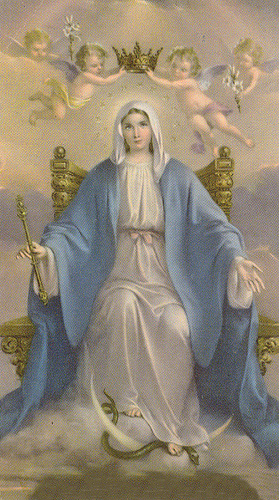
The Rosary is made up of twenty "mysteries" (significant events or moments in the life of Jesus and Mary). The Vatican web site says "The Fifth Glorious Mystery is "The crowning of Our Lady Queen of Heaven". [01]
In an 1849 encyclical addressed to the bishops of the Church, Pope Pius Ithat everyone may know that through her are obtained every hope, every grace, and all salvation. For this is His will, that we obX wrote (Emphasis Added)
The foundation of all Our confidence, as you know well, Venerable Brethren, is found in the Blessed Virgin Mary. For, God has committed to Mary the treasury of all good things, in order tain everything through Mary. (St. Bernard, In Nativit. S. Mariae de Aquaeductu) [02]
Almost 100 years later Mary's Queenship was formally established in the Ad Caeli Reginam - an encyclical or papal letter sent to all Roman Catholic bishops throughout the world by Pope Pius XII, on the 11th of October, 1954. It said ... (Emphasis Added)
Mary was chosen as Mother of Christ in order that she might become a partner in the redemption of the human race; As Christ, the new Adam must be called a King not merely because He is Son of God, but also because He is our Redeemer, so, analogously, the Most Blessed Virgin is queen not only because she is Mother of God, but also because, as the new Eve, she was associated with the new Adam. [03]
In fact, the Second Council of Nicæa declared a person to be anathema (A vehement denunciation) if they did not... (Emphasis Added)
"... confess the holy ever-virgin Mary, truly and properly the Mother of God, to be higher than every creature whether visible or invisible, and does not with sincere faith seek her intercessions as of one having confidence in her access to our God, since she bare him, etc." [04]
However...
The Title "Queen of Heaven" Was Given Several Ancient ‘Goddesses’
The term "Queen of Heaven" (mentioned several time in the book of Jeremiah) was well known to ancient cultures. In fact a number of goddesses in the ancient Mediterranean and Near East bore the same title. Perhaps, two of the best known are Ishtar also known as Isis, and Inanna known by many names.
Note: It was a fairly common occurrence for goddesses to be adopted then renamed by various cultures which makes it difficult to keep track of them. What we do know is that Ishtar (Ashtoreth in Hebrew and Astarte in Greek) was the most popular and widely worshipped deity in ancient Mesopotamia.
The Babylonians worshiped Ishtar as "The Virgin," "The Holy Virgin," "The Virgin Mother," "Goddess of Goddesses," and "Queen of Heaven and Earth." They exclaimed, "Ishtar is great! Ishtar is Queen! My Lady is exalted, my Lady is Queen. . . . There is none like unto her." [05]
In the final analysis, it does not matter if there was a single female deity called by various names, or whether several different goddesses were worshipped. What matters are the many instances of the Israelites turned away from Yahweh to worship other gods, among whom were the male Chemosh, Baal, Milcom, Tammuz (Ezekiel 8:9-16), and the goddess Ashtoreth/Astarte.
For example, 1 Kings 11:5 states that late in his life, King Solomon "became a follower of Ashtoreth the goddess of the Sidonians, and of Milcom the abhorrent idol of the Ammonites". Ashtoreth was Baal's female counterpart and the supreme goddess of Canaan. (1 Kings 11:33, 2 Kings 23:13, Judges 10:6, 1 Samuel 7:3.
Additionally Asherah (mistranslated as "grove" in the King James Version) was an Assyrian goddess mentioned eighteen times in the Old Testament. It is likely that "The Asherah" referred to was a carved tree or pole, that represented the goddess, images of whom were made and worshipped. She also had prophets and vessels used in her service.
Now then send and gather to me all Israel at Mount Carmel, together with 450 prophets of Baal and 400 prophets of the Asherah, who eat at Jezebel's table." (1 Kings 18:19 NASB. Also 2 Kings 23:4)
As mentioned just above ”The Babylonians worshiped Ishtar as "The Virgin," "The Holy Virgin," "The Virgin Mother," etc.”
Of consequence to this article is the fact that Ishtar's New Testament counterpart iwas Artemis - Diana in Latin (See Acts 19) making it more than possible that the title "Queen of Heaven" given Mary originated in Ephesus.
See Details in Return of The Goddesses
What The Bible Says About The 'Queen of Heaven'
The title 'The Queen of Heaven' should set off alarm bells for anyone familiar with the book of Jeremiah through whom God made it very clear that the worship of this "queen of heaven" provoked Him to great anger. God asked the prophet whether he saw
... what they are doing in the cities of Judah and in the streets of Jerusalem? "The children gather wood, the fathers kindle the fire, and the women knead dough to make sacrificial cakes for the queen of heaven; and they pour out drink offerings to other gods in order to provoke Me to anger. (Jeremiah 7:17-18 NASB)
Entire families were involved in the idolatry... the children gathered wood, the fathers kindled the fires, and the women kneaded dough to make cakes for the queen of heaven. The Israelites went so far as to attribute their peace and prosperity to this goddess and refused to stop burning sacrifices or pour out drink offerings to her,
The Father then warned the Israelites through the prophet that by indulging in idol worship they had provoked Him to anger and that they would pay a heavy price. His anger and wrath would be poured out on that place...
"on human and animal life, and on the trees of the field and the fruit of the ground; and it will burn and not be quenched."
However, the people rejected the warning and told Jeremiah ...
As for the message that you have spoken to us in the name of the LORD, we are not going to listen to you! "But we will certainly carry out every word that has proceeded from our mouths, by burning sacrifices to the queen of heaven and pouring out drink offerings to her, just as we ourselves, our forefathers, our kings, and our leaders did in the cities of Judah and in the streets of Jerusalem; for then we had plenty of food and were well off and saw no misfortune.
But since we stopped burning sacrifices to the queen of heaven and pouring out drink offerings to her, we have lacked everything, and have met our end by the sword and by famine." "And," said the women, "when we were burning sacrifices to the queen of heaven and pouring out drink offerings to her, was it without our husbands that we made for her sacrificial cakes in her image, and poured out drink offerings to her?" (Jeremiah 44:16-19 NASB)
The Lord God responded to this treachery by telling the people to go ahead and do as they wished, but to pay close attention to His words...
This is what the LORD of Hosts, the God of Israel, says: As for you and your wives, you have spoken with your mouths and fulfilled with your hands your words: 'We will surely perform our vows that we have made to burn incense to the Queen of Heaven and to pour out drink offerings to her. 'Go ahead, then, do what you have promised! Keep your vows! Nevertheless, hear the word of the LORD, all you people of Judah living in Egypt:
Behold, I have sworn by My great name, says the LORD, that never again will any man of Judah living in the land of Egypt invoke My name or say, 'As surely as the Lord GOD lives.’ I am watching over them for harm and not for good, and every man of Judah who is in the land of Egypt will meet his end by sword or famine, until they are finished off. Those who escape the sword will return from Egypt to Judah, few in number, and the whole remnant of Judah who went to dwell in the land of Egypt will know whose word will stand, Mine or theirs! (Jeremiah 44:25-28 BSB)
In an earlier chapter the Father had already told Jeremiah what the consequences of the nations adultery would be
As for you, do not pray for this people, and do not lift up cry or prayer for them, and do not intercede with Me; for I do not hear you. Do you not see what they are doing in the cities of Judah and in the streets of Jerusalem? The children gather wood, and the fathers kindle the fire, and the women knead dough to make cakes for the queen of heaven; and they pour out drink offerings to other gods in order to spite Me". "Do they spite Me?" declares the LORD. "Is it not themselves they spite, to their own shame?" Therefore thus says the Lord GOD, "Behold, My anger and My wrath will be poured out on this place, on man and on beast and on the trees of the field and on the fruit of the ground; and it will burn and not be quenched." (Jeremiah 7:16-20 NASB)
Pope Pius XII And The Origins of The Title 'Queen of Heaven' (Ad Caeli Reginam)
As previously mentioned, the 'queenship' of Mary was formally established by Pope Pius XII in Ad Caeli Reginam, a 1954 papal encyclical or letter, written in 52 points. In reading through the encyclical, one fact that jumps out is that it makes very few references to the Scriptures, but quotes the writings of early church authors innumerable times.
In other words, tradition and opinion, rather than God's word, took center stage.
Some of the authors quoted were Ephrem, Gregory Nazianzen, Prudentius, Origen, Jerome, Chrysologus, Epiphanius (bishop of Constantinople), Andrew of Crete, Germanus, John Damascene, Ildephonsus of Toledo etc., many of whom waxed very eloquent in their elevation of Mary. The encyclical says,
St. Andrew of Crete frequently attributes the dignity of a Queen to the Virgin Mary. For example, he writes, "Today He transports from her earthly dwelling, as Queen of the human race, His ever-Virgin Mother, from whose womb He, the living God, took on human form."[19]
And in another place he speaks of "the Queen of the entire human race faithful to the exact meaning of her name, who is exalted above all things save only God himself."
Likewise St. Germanus speaks to the humble Virgin in these words: "Be enthroned, Lady, for it is fitting that you should sit in an exalted place since you are a Queen and glorious above all kings."[21] He likewise calls her the "Queen of all of those who dwell on earth."
She is called by St. John Damascene "Queen, ruler, and lady," and also "the Queen of every creature."
Another ancient writer of the Eastern Church calls her "favored Queen," "the perpetual Queen beside the King, her son," whose "snow-white brow is crowned with a golden diadem."
And finally St. Ildephonsus of Toledo gathers together almost all of her titles of honor in this salutation: "O my Lady, my Sovereign, You who rule over me, Mother of my Lord . . . Lady among handmaids, Queen among sisters." [06]
See More About Gregory of Nazianzus in Is God a Trinity? - Part VI
The Cappadocian Fathers - Greek Philosophers and Catholic Mystics HERE
The encyclical also mentions Origen, St. Jerome, and St. Chrysologus all three of whom seemed to have made it up as they went along
Origen:
In one of the homilies attributed to Origen he says Elizabeth calls Mary "the Mother of my Lord." and even addresses her as "Thou, my Lady."
I have to wonder what New Testament Origen was reading (if indeed he was reading one at all), as the phrase "my lady" is conspicuous by its absence. What the Biblical text actually says is Mary....
"... entered the house of Zacharias and greeted Elizabeth. When Elizabeth heard Mary's greeting, the baby leaped in her womb; and Elizabeth was filled with the Holy Spirit. And she cried out with a loud voice and said, "Blessed are you among women, and blessed is the fruit of your womb! "And how has it happened to me, that the mother of my Lord would come to me? "For behold, when the sound of your greeting reached my ears, the baby leaped in my womb for joy. "And blessed is she who believed that there would be a fulfillment of what had been spoken to her by the Lord." (Luke 1:40-45 NASB)
But this is hardly surprising since Origen, known for introducing Greek ideas into Christianity, often flatly contradicted the Scriptures. He taught the pre-existence of souls, the final reconciliation of all creatures (possibly even Satan), and the subordination of the Son to the Father. In fact, the Fifth Ecumenical Council (The Second Council of Constantinople) passed 15 anathemas against Origen's teachings [07]. Yet, later popes didn't seem to have an issue with quoting him when it suited them as do many evangelicals
It is well beyond me why so many Evangelicals quote rank heretics like Augustine and Origen.
Besides which historical accuracy that is invariably quite complex has, all too often, given place to popular legend and over simplification that most Christians unquestioningly and uncritically accept. Ignoring everything they were wrong about, we have made them the object of great attention and devotion, held them up as icons to be emulated, written numerous books about them, and even erected statues to their memory.
This article is devoted to one such person Martin Luther whose diatribes against the Jews were appalling
Jerome:
Jerome - a fourth-fifth century Latin priest, theologian, historian, and doctor of the Church - made the following statement "We should realize that Mary means Lady in the Syrian Language."
However, the New Testament was not written in Syriac but in Greek therefore, whatever "Mary" means in Syriac has no bearing on the matter. In Greek, the name Mary is Maria or Mariam, which came from the Hebrew Miryam. In turn Miryam is derived from merur which means bitterness or rebellion.
St. Chrysologus:
St. Chrysologus went a step further claiming that "The Hebrew word 'Mary' means 'Domina.' The Angel therefore addresses her as 'Lady' to preclude all servile fear in the Lord's Mother, who was born and was called 'Lady' by the authority and command of her own Son".
1) 'Mary' and 'Domina' are two vastly different words. As said above, Mary is the Greek Maria or Mariam, which came from the Hebrew Miryâm.
Miryam,
an ancient Hebrew name, was quite common in the Old Testament. The Greek versions, Maria or Mariam (English Mary), were equally common names among Palestinian Jews. Richard J. Bauckham, widely published scholar in theology, historical theology and New Testament studies, says almost 30 percent of women
"bore one of the two most popular names, Mary and Salome" [08] which means that close to one in five women were called Mary, a fact that hardly leans towards placing any particular importance on the name.
In fact, the name was so common that several different women called Mary are not only mentioned in the New Testament but, although their identities are not completely agreed on, at least three were present at the crucifixion named by John as Mary Magdalene, Mary the wife of Clopas, and Jesus' mother Mary. (John 19:25)
On the other hand,
Domina
The name "Domina" has its roots in Latin, where it is derived from the word "dominus," which means "lord" or "master." In its feminine form, "Domina" translates to "mistress" or "lady." Historically, it was used to denote a woman of authority or a woman who held power over a household or estate. The term is also associated with the concept of dominion and control, reflecting a position of influence. [09]
Dominus the Latin title of feudal lords etc. was a shortened form of the Latin word Dominus. It was a common prefix for monks and priests in religious orders before the Reformation.
2) The angel did not address Mary as "Lady". Gabriel's exact words were "Greetings, favored one! The Lord is with you." (Luke 1:28 NASB). The word translated "favored" is the Greek charitoo, which means to give special honour or be favored. It is used one other time in the New Testament where God is said to bestow grace on believers.
to the praise of the glory of His grace, with which He favored (Gk. charitoo) us in the Beloved. (Ephesians 1:6 NASB)
See more in the article on the Immaculate Conception
(section Mary, Full Of Grace - Graced From Conception?
To sum up, at least three of the men quoted in the papal encyclical Ad Caeli Reginam had their facts completely skewed. Yet, the average Catholic reading this letter without doing any research for themselves is likely to believe every word on the assumption that the pope and the men he quoted knew what they were talking about.
Part II - Other Texts Put Forward As Evidence For Mary's Exalted Status
Many Catholics endeavor to show that Mary's exalted status is justified based on a supposedly significant role played by the mothers of various kings in the history of Israel. The logic being that when Christ ultimately and eternally takes His rightful place on the throne of David, Mary will have the honor of being 'Queen Mother' in God's kingdom.
Solomon and Bathsheba
Catholics take two details in 1 Kings 2:19 to indicate Mary's importance. The verse reads...
So Bathsheba went to King Solomon, to speak to him for Adonijah. And the king stood to meet her, bowed to her, and sat on his throne; then he had a throne set up for the king’s mother, and she sat on his right. (1 Kings 2:19 NASB)
1.) Solomon Pulled up A 'Throne' For His Mother?
One argument used in favor of the status of the king's mother is that when Bathsheba went to King Solomon to speak to him on Adonijah's behalf, Solomon rose to meet her, bowed, then had a "throne" set on his right for her. (1 Kings 2:19).
Although the same word (kissêh) was used both for Solomon's seat and the one he had set for his mother, it does not necessarily mean that both occurrences meant a "throne". There is no doubt that the majority of uses of kissêh are used for an actual royal throne - God's throne (Isaiah 66:1), David's throne (Jeremiah 22:2) The Pharaoh's throne (Exodus 11:5), the king of Nineveh's throne (Jonah 3:6) etc.
However, kissêh also refers to a seat or stool. It is used to describe what Eli the priest was sitting on near the door of the temple and, later, by the side of the road.
Then Hannah rose after eating and drinking in Shiloh. Now Eli the priest was sitting on the seat (Heb. kissêh) by the doorpost of the temple of the LORD. (1 Samuel 1:9 NASB)
Considering it would have been immeasurably rude for Solomon to have kept his mother standing, it stands to reason that when she walked in he had a seat of some sort pulled up so she could sit down? That he pulled up a throne for her does not make any sense. In any royal setting there is usually just the one throne - a heavy, ornate piece of furniture for the king that cannot be easily manipulated or moved.
1.) Solomon's Seated His Mother On His Right
The fact that the verse mentions that Solomon seated his mother on his right could just mean that he had great respect for her. We cannot possibly interpret this as meaning that this was the normal procedure of the day. Nor can we make the leap and apply this to Christ and Mary ie. He will seat Mary on His right.
In any case the Bible does not support the idea of Mary sitting at God's right hand
John's speaks of the "the throne of God", "God who sits on the throne", "the Lamb in the center of the throne", "the throne of God and of the Lamb" etc. Although John even describes a great multitude standing before the throne, he says absolutely nothing about Mary at the king's right hand.
After these things I looked, and behold, a great multitude which no one could count, from every nation and all tribes and peoples and tongues, standing before the throne and before the Lamb, clothed in white robes, and palm branches were in their hands; and they cry out with a loud voice, saying, 'Salvation to our God who sits on the throne, and to the Lamb.'" (Revelation 7:9-10 NASB)
For this reason, they are before the throne of God; and they serve Him day and night in His temple; and He who sits on the throne will spread His tabernacle over them. They will hunger no longer, nor thirst anymore; nor will the sun beat down on them, nor any heat; for the Lamb in the center of the throne will be their shepherd, and will guide them to springs of the water of life; and God will wipe every tear from their eyes." (Revelation 7:15-17 NASB)
Then he showed me a river of the water of life, clear as crystal, coming from the throne of God and of the Lamb" (Revelation 22:1 NASB)
And, as a by the way, perhaps you have noticed that the Holy Spirit was also missing from other visions of God's throne seen by Daniel, Stephen and John. In fact, the third person of a supposedly triune God is curiously absent from the left hand of the Father, all New Testament doxologies, and the opening salutation of most of the New Testament books.
See Is God a Trinity?
 Note: Challenging the doctrine of the Trinity does not mean challenging the Divinity of Christ and it does not mean challenging the Divinity of the Holy Spirit. The New Testament abounds with much proof of the deity of Jesus Christ and Acts 5:3-4 is more than enough to clinch the issue of the Holy Spirit being God.
However, there is absolutely no evidence that the Holy Spirit is the 'third person of the Trinity. Theologians over simplify the matter when they state that the Biblical evidence permits only one of two conclusion a) Jesus and the Holy Spirit are not Divine, or b) God is a Tri-unity. It's either this or that... take it or leave it.)
2 Kings 24:14-15
Others place importance on the fact that, as related in the second book of Kings, Nebuchadnezzar carried the king's mother into captivity. While it stands to reason that the mother of the king would have been an important person in the kingdom, the verse says the kings entire family, including his wives, his mother (Heb. êm), the officials and leading men of the land were ALL led away into captivity. There is NO particular emphasis on the mother of the king. In fact Nebuchadnezzar also took a bunch of other people captive.
Then he led away into exile all Jerusalem and all the captains and all the mighty men of valor, ten thousand captives, and all the craftsmen and the smiths. None remained except the poorest people of the land. So he led Jehoiachin away into exile to Babylon; also the king's mother (Heb. êm) and the king's wives and his officials and the leading men of the land, he led away into exile from Jerusalem to Babylon. (2 Kings 24:14-15 NASB)
Why It's Not Very Wise To Use The Intercessory Role of The King's Mother
In an article entitled Mary Queen of Heaven - the Bible Tells Me So, Fr. Dwight Longenecker says
Mary as the Queen of Heaven is tied in with the Old Testament concept of the royal household. Because the King had many wives it was impossible for one to be Queen. Therefore the King's mother served in the role.
The Queen Mother sat on a throne at the King's right hand and helped rule the kingdom. Access to the King would often be through the Queen Mother and she would ask favors from the King for those who asked her. You can see an example of this in I Kings 2: 17-25 where Solomon is on the throne next to his mother Bathsheba. [10]
In the first place why are assuming that what humans do or not do on earth is necessarily reflected in Heaven. And why do we elaborate and expand ONE incident to mean that the king's mother had an 'intercessory role'.
In any case, using Bathsheba's supposed intercessory role as a precedent is a very bad idea.
When Adonijah David and Haggith's son (David's fourth - 2 Samuel 3:4) came to Bathsheba and asked her to she intercede with Solomon on his behalf and give him Abishag the Shunammite as a wife he not only refused her, but also had Adonijah put to death that very day (1 Kings 2:24-25).
Besides which one king (Asa) had an apostate mother whom he had to remove from the rank and state of queen-mother.
He also removed Maacah his mother from being queen mother (Heb. gebîyrâh), because she had made a horrid image as an Asherah; and Asa cut down her horrid image and burned it at the brook Kidron. (1 Kings 15:9-13 NASB
The Wedding at Cana
The wedding in Cana is also used as an example of Mary interceding with Jesus on behalf of a person or persons - one Catholic site saying,
John is careful to note that Jesus' first miracle (at Cana) is done in response to Mary's intercession ( John 2:1–11). [11]
Another says
Apparently Mary noticing that the wine had run out (which undoubtedly would have caused considerable embarrassment) asked Jesus to help. He, although His time had not yet come, performed the miracle of turning water in to wine... not only enough for the wedding party but if, as some figure, each of the six stone water pots held twenty or thirty gallons, with plenty left over.
In other words, Jesus helped the newly wed couple because His mother asked Him to... And, as He heeded her request then, He heeds her requests now.
But, is this exactly what happened? And is the point of the story the efficacy of Mary's intercession?
It is important to note that Mary never specifically asked Jesus for a miracle, but simply apprised Him of the situation. This is hardly surprising. Although Mary knew He was the promised Messiah as far as we know she had never seen Him do anything that could be termed miraculous. Jesus' answer should be thought-provoking. He neither turned His mother down nor agreed to her request. Instead His response was
"Woman, what does that have to do with us? My hour has not yet come."
It is also to be noted that Mary was neither offended nor upset. She did not argue and she did not plead, but simply turned to the servants and told them to do whatever Jesus instructed them to do. This should make it pretty obvious that she left the entire matter in the hands of her Son to do as He wished.
I recently read a post by Supreme Chaplain Bishop William E. Lori on the Knights of Columbus Catholic web site. In his words... (Emphasis Added)
Yet, Mary persisted, remembering the signs and wonders that accompanied Jesus' coming into the world. She urged her son to reveal something of his glory in anticipation of his "hour" — that is, the hour of his saving death and resurrection. [13]
Which is a classic case of making it up as you go along. The Bible says absolutely nothing about any of these extras details he added to the story (something that seems to be done with clockwork regularity). Unless the Bishop happened to be one of the guests at the wedding, there is no way he could know Mary "urged her son to reveal something of his glory" - much less what she was remembering at the time.
So what was the point of the story of Cana? Most people at the wedding, with the sole exception of Mary, the servants, and the disciples, were apparently completely unaware that a miracle had even taken place.
The Significance Of and Reason For Jesus' First Miracle. (At Least According to John)
Each of the Gospels had a different focus and emphasis which, when seen as a whole, formed a complete picture of who Jesus was. For example,
The Gospel of Matthew, undoubtedly intended for the Jewish community, primarily focuses on Jesus as the Messiah who fulfilled the Old Testament prophecies and thus was the long awaited Messiah.
Luke, an obviously diligent historian specifically addressed his Gospel to one "Theophilus" apparently an important Gentile. He particularly noted that he had investigated everything carefully and decided to compile an account with the aim of showing that the Christian's faith is based upon historically reliable and verifiable events and what Theophilus had been taught was the truth. Luke emphasized Christ's human side often calling Him "Son of Man".
(This is why it made sense that only Matthew and Luke gave us the genealogy of Christ and the Nativity account, which established both Messianic and human lineage)
Mark, Barnabas' cousin and Peter's friend was also primarily writing to the Gentiles leaving out much that would have been important only to a Jew. He emphasized Christ as the suffering Servant, the One who came not to be served, but to serve and give His life a ransom for many (Mark 10:45)
John's Gospel was different. The entire Gospel was focused on the deity of Christ - His eternal divinity. (ie. the Word, the I am statements). It began not with Jesus' birth or ministry but with who He was before His incarnation - "the Word was God" (John 1:1). John emphasized the deity of Christ throughout his Gospel omitting most of Jesus' parables, exorcisms, etc. Instead, it features long discourses, open proclamations of divinity, and Jesus' seven "I am" statements. ,
John himself clearly identified the primary purpose of his Gospel,
but these have been written so that you may believe that Jesus is the Christ, the Son of God; and that believing you may have life in His name. (John 20:31 NASB
And the miracles Jesus did were clear evidence that revealed who Jesus was. The changing the water into wine at Cana was only recorded by John and made a strong impression on His disciples - the first that awakened belief.
This beginning of His signs Jesus did in Cana of Galilee, and manifested His glory, and His disciples believed in Him. (John 2:11 NASB
However, there are also some other less obvious, but extremely significant aspects to the story.
The Abundance Of Wine
Although opinions vary as to how much good wine Jesus made at the wedding, one thing is certain... there was quite a bit of it. It is extremely striking that the Old Testament prophets consistently portrayed an abundance of wine as one of the symbols of the richness and joy of the coming kingdom. For example,
The LORD of hosts will prepare a lavish banquet for all peoples on this mountain; A banquet of aged wine, choice pieces with marrow, And refined, aged wine. (Isaiah 25:6 NASB)
They will come and shout for joy on the height of Zion, And they will be radiant over the bounty of the LORD - Over the grain and the new wine and the oil, And over the young of the flock and the herd; And their life will be like a watered garden, And they will never languish again." (Jeremiah 31:12 NASB)
The threshing floors will be full of grain, And the vats will overflow with the new wine and oil. (Joel 2:24 NASB)
Behold, days are coming," declares the LORD, "When the plowman will overtake the reaper And the treader of grapes him who sows seed; When the mountains will drip sweet wine And all the hills will be dissolved. Also I will restore the captivity of My people Israel, And they will rebuild the ruined cities and live in them; They will also plant vineyards and drink their wine, And make gardens and eat their fruit. (Amos 9:13-14 NASB)
Ephraim will be like a mighty man, And their heart will be glad as if from wine; Indeed, their children will see it and be glad, Their heart will rejoice in the LORD." (Zechariah 10:7 NASB)
These are an echo of the promises made to the nation of Israel in Deuteronomy
"Then it shall come about, because you listen to these judgments and keep and do them, that the LORD your God will keep with you His covenant and His loving kindness which He swore to your forefathers. He will love you and bless you and multiply you; He will also bless the fruit of your womb and the fruit of your ground, your grain and your new wine and your oil, the increase of your herd and the young of your flock, in the land which He swore to your forefathers to give you." (Deuteronomy 7:12-13 NASB)
Does Mary's Foot Crush Satan's Head?
Additionally, in another encyclical addressed to the bishops of the Church, Pope Pius IX asked them for their opinion on the definition of a dogma on the Immaculate Conception of the Virgin Mary.
This led directly to the 1854 Apostolic Constitution Ineffabilis Deus, which officially defined the dogma (a core, authoritative belief). However in this letter Pope Pius, quoting pope Gregory and St. Bernard (possibly Saint Bernard of Clairvaux (1090 - 1153) says (Emphasis Added)
"Great indeed is Our trust in Mary. The resplendent glory of her merits, far exceeding all the choirs of angels, elevates her to the very steps of the throne of God. (St. Gregory, Pope, de Exposit. in libros Regum)
Her foot has crushed the head of Satan. Set up between Christ and His Church, (St. Bernard, Serm. in cap. XII Apocalyps) Mary, ever lovable and full of grace, always has delivered the Christian people from their greatest calamities and from the snares and assaults of all their enemies, ever rescuing them from ruin. [14 ]
The verse being referred to in the second paragraph is Genesis 3:15 in which God directly addressed the serpent. Two versions say,
And I will make enemies Of you and the woman, And of your offspring and her Descendant; He shall bruise you on the head, And you shall bruise Him on the heel.” (Genesis 3:15 NASB)
And I will put enmity between you and the woman, and between your seed and her seed. He will crush your head, and you will strike his heel.” (Genesis 3:15 BSB)
The Father was telling Satan that there would be enmity between his seed and the woman's seed. Although Satan would wound the Messiah by bruising His heel (undoubtedly a reference to the cross) but the Messiah would bruise Satan's head crushing him with a mortal wound. In this, God prophesied Satan's doom ie. his ultimate defeat at the hands of the Messiah.
There is however another aspect to this. The context of Romans 16:20 makes it clear that Paul was addressing the Roman church when he used the words "your" feet. (Emphasis Added)
Everyone has heard about your obedience, so I rejoice over you. But I want you to be wise about what is good and innocent about what is evil. The God of peace will soon crush Satan under your feet. The grace of our Lord Jesus Christ be with you. (Romans 16:19-20 BSB)
This verse tells us that the only Person who will crush the head of the serpent is God Himself. He does the crushing, but Satan ends up under the feet of believers without even the whisper of a hint that Mary will be involved in any way.
However, Catholics will argue that Mary indirectly crushes Satan's head because she brought the Messiah into the world.
Moreover, even though the Hebrew text for this passage does indicate that the seed of the woman will crush the head of the serpent, it's also legitimate to see in the text the woman crushing the serpent's head, at least in an indirect way. The reason is that the woman, Mary, cooperated in the events that led to the serpent's head being crushed. She agreed to be the vessel for the male child to come into the world for the sake of crushing the serpent's head (Luke 1:38). [15 ]
This is simply dreaming up every possible argument that can possibly be seen as supporting the exalted position Rome has placed Mary in.
End Notes
[01] The Mysteries Of The Rosary. Fifth Glorious Mystery: The crowning of Our Lady Queen of Heaven.
http://www.vatican.va/special/rosary/documents/popup/popup05_glo_en.html
[02] Ubi Primum On The Immaculate Conception. Encyclical Of Pope Pius Ix. February 2, 1849.
http://www.papalencyclicals.net/Pius09/p9ubipr2.htm
[03] Ad Caeli Reginam. Encyclical Of Pope Pius Xii On Proclaiming The Queenship Of Mary.
http://www.vatican.va/holy_father/pius_xii/encyclicals/documents/hf_p-xii_enc_11101954_ad-caeli-reginam_en.html
[04] NPNF2-14. The Seven Ecumenical Councils. Second Council of Nicæa (787) The Definition of the Holy, Great, and Ecumenical Seventh Synod. http://www.ccel.org/ccel/schaff/npnf214.xvi.x.html
[05] Renald Showers. The 'Queen of Heaven'. https://israelmyglory.org/article/the-queen-of-heaven/ (Israel My Glory is an outreach ministry of the friends of israel gospel ministry)
[06] Ad Caeli Reginam. Encyclical Of Pope Pius Xii On Proclaiming The Queenship Of Mary.
http://www.vatican.va/holy_father/pius_xii/encyclicals/documents/hf_p-xii_enc_11101954_ad-caeli-reginam_en.html
[07] The Anathemas Against Origen. http://www.ccel.org/ccel/schaff/npnf214.xii.ix.html
[08] Richard Bauckham. Jesus and the Eyewitnesses: The Gospels as Eyewitness Testimony Hardcover. Wm. B. Eerdmans Publishing Company (November 9, 2006) Pg. 71- 72.
[09] Meaning of the first name Domina. https://www.ancestry.com/first-name-meaning/domina
[10] Fr. Dwight Longenecker. Mary Queen of Heaven- the Bible Tells Me So.
http://www.patheos.com/blogs/standingonmyhead/mary-queen-of-heaven-the-bible-tells-me-so
[11] Mark Shea. The Significance of the Wedding at Cana.
https://www.ncregister.com/blog/the-significance-of-the-wedding-at-cana
[12] Gospel's Miracle of Cana: Wedding Wonders UnearthedBy Catholic Shop. https://tinyurl.com/mep786kw
[13] Bishop William E. Lori. The Wedding Feast at Cana posted 12/29/2011.
http://www.kofc.org/en/columbia/detail/2012_01_chaplain_lori_en.html
[14] Pope Pius IX. Ubi Primum (On The Immaculate Conception). CatholicCulture.org. Copyright © 2014 Trinity Communications. http://www.catholicculture.org/culture/library/view.cfm?id=5058
[15] Karlo Broussard. Mary’s Sinlessness and the Wedding Feast at Cana | Year C
https://www.catholic.com/audio/scw/marys-sinlessness-and-the-wedding-feast-at-cana-year-c
|