|
Index to All Eight Articles on Mary
ON THIS PAGE
Emphasis Mine in All Bible Verses
Foreword
The Immaculate Conception
Mary - Graced From Conception?
Filled With God's Presence?
Was Mary a Perfect Human Being?
Mankind's Deep Seated Need For A 'Mother Figure'
A Handbook of the Catholic Faith (Endorsed by The Church)
Summary and Conclusion
Foreword
The Catholic Church teaches that its traditions are just as authoritative as Scripture. In an encyclical (Ineffabilis Deus) Pope Pius declared that
A claim one can dismiss as meaningless if any of their doctrines are found to contradict the Scriptures..
And there are plenty of those
In this case, if the doctrine of the Immaculate Conception is shown to be false, it puts also paid to the concept of papal infallibility simply because Pope Pius IX was allegedly exercising that power when he declared Mary to be conceived without sin.
The Immaculate Conception
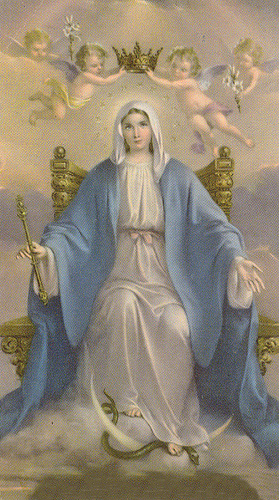
Has nothing to do with Jesus' birth. It is a Catholic dogma that states that Mary, whose conception was brought about the normal way, was conceived without original sin.
Although undoubtedly every true believer has the deepest respect for the mother of our Lord, the Catholic Church takes it many steps further teaching that Jesus' earthly mother was herself conceived free from the stain of original sin ie. she was immaculately conceived. And that is not all. The Catechism states that not only was Mary born free of original sin but never even sinned all the time she was alive.
The Catechism of the Catholic Church states that she...
411 "... was preserved from all stain of original sin and by a special grace of God committed no sin of any kind during her whole earthly life. [02]
773 "Mary goes before us all in the holiness that is the church's mystery as the 'bride without spot or wrinkle'" [03]
The doctrine of the Immaculate Conception only became official dogma in 1854 after centuries of debate when Pope Pius IX proclaimed
The most Blessed Virgin Mary was, from the first moment of her conception, by a singular grace and privilege of almighty God and by virtue of the merits of Jesus Christ, Saviour of the human race, preserved immune from all stain of original sin. [04]
This article could be concluded right here simply because there is no such thing as "Original Sin"
See Original Sin - Fact or Fable
Many Christians today including most Anglicans, Lutherans, Methodists, Presbyterians and Catholics unblushingly subscribe to the view that the sin of Adam was transferred to all future generations tainting even the unborn. This makes me wonder how many who profess to believe in Original Sin have given any thought to the fact that sin is not a substance with physical properties that can be transmitted from person to person like a virus.
Much to the contrary, sin is a conscious, willful act performed by an individual (in thought, word or deed)
that transgresses God's law. Think about it - sin can not even exist unless a sinner has an immoral, unrighteous thought then acts on it. Besides which, if sin can be inherited there is absolutely no reason why virtue, goodness, and righteousness cannot also be passed on.
In other words the false doctrine of Mary's Immaculate Conception was fabricated
on a provably erroneous belief.
In any case, those who believe Mary was free from 'original sin' have to face the fact that in order for that to be true "Mary's parents would have had to be sinlessly conceived for Mary to have escaped their sin, and so on all the way back to Adam". [05]. Emphasis Added
Mary - Graced From Conception?
Luke 1:26-28 reads
Now in the sixth month the angel Gabriel was sent from God to a city in Galilee named Nazareth, to a virgin betrothed to a man whose name was Joseph, of the descendants of David; and the virgin's name was Mary. And coming in, he said to her, " (Gk. kecharitomene )! The Lord is with you.” (Luke 1:26-28 NASB) [06]
Catholic theologians often point to this as biblical evidence for the Immaculate Conception. In other words Mary did not carry the stain of original sin but was grace filled from the moment of her own conception.
Because by definition the word grace means God's undeserved favor (ie. if grace is deserved, it is no longer grace) the emphasis is not on Mary's merit because but on the fact that God had chosen her for a task of utmost importance.
Gabriels exact words were
And coming in, he said to her, "Greetings (Gk. chaire), favored one (Gk. kecharitomene) ! The Lord is with you.” (Luke 1:28 NASB)
Note: kecharitomene derived from charis which means grace or favor, is transliterated charitoo. Transliteration changes the script (how a word is spelled in a new alphabet)
In an article entitled Why Mary Is Always Full of Grace, Nate Guyear posted an examination of the phrase chaire kecharitomene on the web site ‘Catholic Stand’.
Hail, full of grace.' ('chaire kecharitomene' – 'Chaire' means 'hail' or 'rejoice.' 'Charis' means 'grace.' 'Charitoo' is a Greek verb ending in omicron omega ('oo'), which means to put the person or thing into the state indicated by the root. The root being 'charis' or 'grace,' 'charitoo' means to put into a state of grace.
'Ke' is a Greek perfect tense prefix that indicates a perfected, completed present state as a result of past action. Thus, a perfected, completed present state of 'charis,' or 'grace,' as a result of past action.
'Mene' is a Greek passive participle suffix that indicates action performed on the subject by another. Thus, a perfected, completed present state of 'charis,' or 'grace,' as a result of the past action of another. As the speaker is the angel Gabriel, the 'other' is God. Therefore, 'chaire kecharitomene' means, 'Hail, who has been perfectly and completely graced by God.' The common Catholic rendering, 'full of grace,' while good, may actually fall short!
The conclusion being...
Since grace is necessary for salvation, and God graced Mary from the moment of her conception, then God saved her from the moment of her conception. [07].
There is no doubt that the Greek word Ke indicates "a perfected, completed present state as a result of past action" and Mene "indicates action performed on the subject by another" ie. God in this case. However, I am not sure how the leap was made to "God graced Mary from the moment of her conception".
The action of God favoring her could have occurred five minutes before Gabriel arrived (bordering on sarcasm here). All we know is that Gabriel was simply announcing that she was already highly favored inasmuch as she was being given an incredibly momentous task. We simply do not know when she was favored.
Because by definition the word grace means God's undeserved favor (ie. if grace is deserved, it is no longer grace) the emphasis is not on Mary's merit because but on the fact that God had chosen her for a task of utmost importance.
In fact, several giants of the Old Testament were said to have found favor with God none of whom were immaculately conceived. Note that the Hebrew word chen also means favor or grace,
But Noah found favor (Heb. chen) in the eyes of the LORD. (Genesis 6:8)
(Abraham) said, "My Lord, if now I have found favor (Heb. chen) in Your sight, please do not pass Your servant by. (Genesis 18:3 NASB)
Then Moses said to the LORD, "Look, You have been telling me, 'Lead this people up,' but You have not let me know whom You will send with me. Yet You have said, 'I know you by name, and you have found favor (Heb. chen) in My sight.' (Exodus 33:12 BSB)
Gideon answered, "If I have found favor (Heb. chen) in Your sight, give me a sign that it is You speaking with me". (Judges 6:17 BSB)
If I have found favor (Heb. chen) in the sight of the king, and if it pleases the king to grant my petition and fulfill my request, may the king and Haman come tomorrow to the banquet I will prepare for them. Then I will answer the king's question.” (Esther 5:8 BSB)
Filled With God's Presence?
Pope Francis who reflected on Mary's sinlessness in St. Peter's Square on Dec. 8, 2017 said the following ...(Emphasis Added)
"... when the angel Gabriel appeared to Mary to ask her to be the mother of God, Gabriel "calls her full of grace and thus reveals the new name that God has given her and which is more becoming to her than the name given to her by her parents. We too call her in this way, with each Hail Mary.
What does "full of grace" mean? That Mary is filled with the presence of God. And if she is entirely inhabited by God, there is no room within her for sin. [08]
The Greek word charitoo rendered 'favored' does NOT mean "filled with the presence of God" as Pope Francis claimed. Charitoo, a verb derived from the noun charis that means grace or blessing. [09] means to bestow grace, show kindness, or endow with special honor.
It is not only preeminently used when the Lord is disposed to bless someone but is the perfect tense which highlights a completed act with continuing effects.
Note that charis was also applied to believers in the New Testament. In other words we are saved because of God's favor or grace.
On the contrary, we believe it is through the grace (Gk. charis) of the Lord Jesus that we are saved, just as they are." (Acts 15:11 BSB)
... God, who is rich in mercy, made us alive with Christ even when we were dead in our trespasses. It is by grace (Gk. charis) you have been saved! (Ephesians 2:5 BSB)
Was Mary a Perfect Human Being?
There are several factors in Scripture that contradict the belief that Mary was a perfect human being -
Luke 1:46-47
Mary's Song of Praise - The Magnificat begins with the words, "My soul magnifies the Lord, and my spirit rejoices in God my Savior! (Luke 1:46-47 BSB)
A sinless person does not need a savior. (Link To The Real Mary of The Bible below)
Romans 3:23
for all have sinned and fall short of the glory of God, (Romans 3:23 BSB)
It is a universal statement - no exceptions except for the Messiah who "God presented Him as the atoning sacrifice through faith in His blood, in order to demonstrate His righteousness" (V. 25)
So why has Mary been raised to such a sublime status?
Mankind's Deep Seated Need For A 'Mother Figure'.
Because motherhood is a universal reality mankind seems to have a deep seated need for the 'Eternal Feminine'.
The worship of mother goddesses has come down from early prehistoric fertility cults to sophisticated organized religions and remains a significant part of modern pagan beliefs.
The pull toward a mother figure is a deeply felt worldwide impulse that has kindled the veneration of female sacred images for thousands of years. It is likely a regression into the experience of total dependence, safety, and nourishment provided by the biological mother.
Re-connecting with a female deity allows adults to psychologically re-engage with primary comfort. Thus virtually every culture features primary female deities - mother goddesses who embody the concepts of motherhood and fertility. Catholicism is no different.
See Original Sin - Fact or Fable
Many Christians today including most Anglicans, Lutherans, Methodists, Presbyterians and Catholics unblushingly subscribe to the view that the sin of Adam was transferred to all future generations tainting even the unborn. This makes me wonder how many of those that profess to believe in Original Sin have given any thought to the fact that sin is not a substance with physical properties that can be transmitted from person to person like a virus.
Much to the contrary, sin is a conscious, willful act performed by an individual (in thought, word or deed)
that transgresses God's law. Think about it - sin can not even exist unless a sinner has an immoral, unrighteous thought then acts on it. Besides which, if sin can be inherited there is absolutely no reason why virtue, goodness, and righteousness cannot also be passed on.
A Handbook of the Catholic Faith (Endorsed by The Church)
Wayne Jackson one of the founders of Christian Courier mentions running across (Emphasis Added)
"... the following quotation from a small volume titled, A Handbook of the Catholic Faith (Garden City, NY: Image Books, 1956). The work was authored by N.G.M. Van Doornik, S. Jelsma, & A. Van De Lisdonk. The book has the Imprimatur (official endorsement) of the Roman Church. What is rather amazing is the fact that these authorities happily admit that there is no biblical authority for this curious dogma. Note the following:
This point of doctrine (the immaculate conception) is not expressly dealt with anywhere in the Bible, nor was it preached by the Apostles, and for many centuries it was not mentioned at all by the Church. Gradually, however, as the idea of the future dogma began to develop among the faithful, theologians submitted the point to the closest examination, and finally, the view then generally prevailing was formally pronounced as a dogma of the Church by His Holiness Pope Pius IX in 1854" (p. 238).
Please note the devastating concessions:
The doctrine of the "immaculate conception" is not taught "anywhere in the Bible."
The idea was unknown to the apostles.
It was alien to the church for centuries.
The notion gradually evolved with time.
It is without divine sanction, having no higher "authority" than that of the "Church" with its papacy and councils. [10]
Summary and Conclusion
There is no question that Mary has a honored place in the Scriptures and was undoubtedly a godly young woman, but Catholicism has not only exaggerated her qualities but elevated her to a position that no human has ever achieved nor can ever aspire to.
In fact, pompous and pretentious grandiloquence has replaced very impressive Scriptural truths. We have lost sight of a very human woman who in her complete trust and obedience in the Father has much to teach us.
See The Real Mary of The Bible (Includes the Magnificat)
Mary's deep familiarity with and faith in the word of God, her grasp of His purposes and promises, her gratitude for the grace He bestowed on her, her submission to His will, and the very breath and scope of her vision are all reflected in her short hymn of praise called The Magnificat (also known as the Canticle of Mary) recorded in Luke 1:46-55. There are quite a few points to be noted here, especially the fact that Mary's theology was vastly superior to that of the scribes and Pharisees.
End Notes
[01] Papal Encyclicals Online. Ineffabilis Deus. The Immaculate Conception
https://www.papalencyclicals.net/pius09/p9ineff.htm
[02] Catechism of the Catholic Church
https://www.catholicculture.org/culture/library/catechism/cat_view.cfm?recnum=634
[03] Catechism of the Catholic Church.
https://www.catholicculture.org/culture/library/catechism/cat_view.cfm?recnum=2975
[04] The Holy See. Catechism Part One Section Two I. https://tinyurl.com/bdd5rnaj
[05] Steven J. Cole. Should Christians Hail Mary? Bible.org.
https://bible.org/seriespage/lesson-4-should-christians-hail-mary-luke-126-45
[06] https://biblehub.com/interlinear/luke/1-28.htm
[07] Nate Guyear. Why Mary Is Always Full of Grace. https://tinyurl.com/mryzz6yw
[08] Deacon George Hooper https://diobr.org/news/mary-sinless-understanding-the-trinity
[09] https://biblehub.com/greek/5485.htm
[10] Wayne Jackson. Christian Courier. False Teaching Regarding Mary
https://christiancourier.com/articles/false-teaching-regarding-mary
|