|
An anathema is a curse or denunciation by ecclesiastical authority pronounced by a council, pope or bishop. The word comes from Galatians 1:9 - "As we have said before, even now I say again: if anyone is preaching to you a gospel contrary to what you received, he is to be accursed!
Rome and the Council of Trent [01]
Some would have us believe that the Roman Catholic Church has changed and that it is no longer the heretical institution that it once was. Ted Haggard, fallen senior pastor of New Life Church in Colorado Springs and former president of the 30-million-member National Association of Evangelicals (NAE), said in October 2005: "New Life doesn't try to 'convert' Catholics" and that the church would never discourage its members "from becoming Catholic or attending Catholic Mass" (Berean Call, Jan. 2006).
This statement reflects a radical change in evangelicalism but, when it comes to Rome, little of significance has changed.
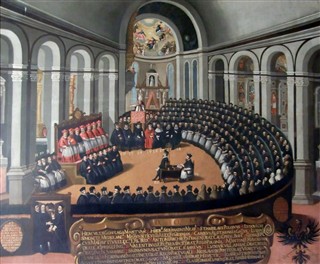
The Council of Trent was a Catholic council held from 1545 to 1563 in an attempt to destroy the progress of the Protestant Reformation. This council denied every Reformation doctrine, including Scripture alone and grace alone. See Sola Scriptura (Scripture alone)
Trent hurled 125 anathemas (eternal damnation) against Bible-believing Christians, including these:
The Scriptures
FOURTH SESSION: DECREE CONCERNING THE CANONICAL SCRIPTURES: "If anyone does not accept as sacred and canonical the aforesaid books in their entirety and with all their parts [the 66 books of the Bible plus 12 apocryphal books, being two of Paralipomenon, two of Esdras, Tobias, Judith, Wisdom, Ecclesiasticus, Baruch, Sophonias, two of Macabees], as they have been accustomed to be read in the Catholic Church and as they are contained in the old Latin Vulgate Edition, and knowingly and deliberately rejects the aforesaid traditions, LET HIM BE ANATHEMA."
See The Canon of Scripture - Part II - The Apocrypha
Did Protestants "remove" seven books from the Old Testament?
Justification
SIXTH SESSION, CANONS CONCERNING JUSTIFICATION: "If anyone says that justifying faith is nothing else than confidence in divine mercy, which remits sins for Christ's sake, or that it is this confidence alone that justifies us, LET HIM BE ANATHEMA" (Canons Concerning Justification, Canon 12).
SIXTH SESSION, CANONS CONCERNING JUSTIFICATION: "If anyone says that the justice received is not preserved and also not increased before God through good works, but that those works are merely the fruits and signs of justification obtained, but not the cause of its increase, LET HIM BE ANATHEMA" (Canons Concerning Justification, Canon 24).
SIXTH SESSION, CANONS CONCERNING JUSTIFICATION: "If anyone says that the Catholic doctrine of justification as set forth by the holy council in the present decree, derogates in some respect from the glory of God or the merits of our Lord Jesus Christ, and does not rather illustrate the truth of our faith and no less the glory of God and of Christ Jesus, LET HIM BE ANATHEMA" (Canons Concerning Justification, Canon 33).
The Sacraments
CANON IV. -If any one saith, that the sacraments of the New Law are not necessary unto salvation, but superfluous; and that, without them, or without the desire thereof, men obtain of God, through faith alone, the grace of justification;-though all (the sacraments) are not necessary for every individual; let him be anathema.
CANON V. -If any one saith, that these sacraments were instituted for the sake of nourishing faith alone; let him be anathema [General Council of Trent: Seventh Session. https://www.papalencyclicals.net/councils/trent/seventh-session.htm ]
Baptism
SEVENTH SESSION, CANONS ON BAPTISM: "If anyone says that in the Roman Church, which is the mother and mistress of all churches, there is not the true doctrine concerning the sacrament of baptism, LET HIM BE ANATHEMA" (Canons on Baptism, Canon 3).
SEVENTH SESSION, CANONS ON BAPTISM: "If anyone says that baptism is optional, that is, not necessary for salvation, LET HIM BE ANATHEMA" (Canons on Baptism, Canon 5).
SEVENTH SESSION, CANONS ON BAPTISM: "If anyone says that children, because they have not the act of believing, are not after having received baptism to be numbered among the faithful, and that for this reason are to be re baptized when they have reached the years of discretion; or that it is better that the baptism of such be omitted than that, while not believing by their own act, they should be baptized in the faith of the Church alone, LET HIM BE ANATHEMA" (Canons on Baptism, Canon 13).
See Baptism
Confirmation
SEVENTH SESSION, CANONS ON CONFIRMATION: "If anyone says that the confirmation of those baptized is an empty ceremony and not a true and proper sacrament; or that of old it was nothing more than a sort of instruction, whereby those approaching adolescence gave an account of their faith to the Church, LET HIM BE ANATHEMA" (Canons on Confirmation, Canon 1).
The Mass
TWENTY-SECOND SESSION, CANONS ON THE SACRIFICE OF THE MASS: "If anyone says that in the Mass a true and real sacrifice is not offered to God; or that to be offered is nothing else than that Christ is given to us to eat, LET HIM BE ANATHEMA" (Canons on the Sacrifice of the Mass, Canon 1).
TWENTY-SECOND SESSION, CANONS ON THE SACRIFICE OF THE MASS: "If anyone says that by those words, Do this for a commemoration of me, Christ did not institute the Apostles priests; or did not ordain that they and other priests should offer His own body and blood, LET HIM BE ANATHEMA" (Canons on the Sacrifice of the Mass, Canon 2).
TWENTY-SECOND SESSION, CANONS ON THE SACRIFICE OF THE MASS: "If anyone says that the sacrifice of the Mass is one only of praise and thanksgiving; or that it is a mere commemoration of the sacrifice consummated on the cross but not a propitiatory one; or that it profits him only who receives, and ought not to be offered for the living and the dead, for sins, punishments, satisfactions, and other necessities, LET HIM BE ANATHEMA" (Canons on the Sacrifice of the Mass, Canon 3).
TWENTY-SECOND SESSION, CANONS ON THE SACRIFICE OF THE MASS: "If anyone says that it is a deception to celebrate Masses in honor of the saints and in order to obtain their intercession with God, as the Church intends, LET HIM BE ANATHEMA" (Canons on the Sacrifice of the Mass, Canon 5).
See The Mass The Mass - An Actual Sacrifice? And Transubstantiation
The Eucharist
THIRTEENTH SESSION, CANONS ON THE MOST HOLY SACRAMENT OF THE EUCHARIST: "If anyone denies that in the sacrament of the most Holy Eucharist are contained truly, really and substantially the body and blood together with the soul and divinity of our Lord Jesus Christ, and consequently the whole Christ, but says that He is in it only as in a sign, or figure or force, LET HIM BE ANATHEMA" (Canons on the Most Holy Sacrament of the Eucharist, Canon 1).
THIRTEENTH SESSION, CANONS ON THE MOST HOLY SACRAMENT OF THE EUCHARIST: "If anyone says that Christ received in the Eucharist is received spiritually only and not also sacramentally and really, LET HIM BE ANATHEMA" (Canons on the Most Holy Sacrament of the Eucharist, Canon 8).
See Transubstantiation
Penance
FOURTEENTH SESSION, CANONS CONCERNING THE MOST HOLY SACRAMENT OF PENANCE: "If anyone says that in the Catholic Church penance is not truly and properly a sacrament instituted by Christ the Lord for reconciling the faithful of God as often as they fall into sin after baptism, LET HIM BE ANATHEMA" (Canons Concerning the Most Holy Sacrament of Penance, Canon 1).
FOURTEENTH SESSION, CANONS CONCERNING THE MOST HOLY SACRAMENT OF PENANCE: "If anyone denies that sacramental confession was instituted by divine law or is necessary to salvation; or says that the manner of confessing secretly to a priest alone, which the Catholic Church has always observed from the beginning and still observes, is at variance with the institution and command of Christ and is a human contrivance, LET HIM BE ANATHEMA" (Canons Concerning the Most Holy Sacrament of Penance, Canon 7).
FOURTEENTH SESSION, CANONS CONCERNING THE MOST HOLY SACRAMENT OF PENANCE: "If anyone says that the confession of all sins as it is observed in the Church is impossible and is a human tradition to be abolished by pious people; or that each and all of the faithful of Christ or either sex are not bound thereto once a year in accordance with the constitution of the great Lateran Council, and that for this reason the faithful of Christ are to be persuaded not to confess during Lent, LET HIM BE ANATHEMA" (Canons Concerning the Most Holy Sacrament of Penance, Canon 8).
FOURTEENTH SESSION, CANONS CONCERNING THE MOST HOLY SACRAMENT OF PENANCE: "If anyone says that God always pardons the whole penalty together with the guilt and that the satisfaction of penitents is nothing else than the faith by which they perceive that Christ has satisfied for them, LET HIM BE ANATHEMA" (Canons Concerning the Most Holy Sacrament of Penance, Canon 8).
See Catholic Confession
Sacrament of Order
IPS Note: The Sacrament of Holy Orders is the rite through which the mission entrusted by Jesus to his apostles continues in the Church. It incorporates baptized men into one of three degrees of apostolic ministry: bishop (episcopate), priest (presbyterate), or deacon (diaconate). The word "holy" means "set apart for a sacred purpose".
TWENTY-THIRD SESSION, CANONS ON THE SACRAMENT OF ORDER: "If anyone says that there is not in the New Testament a visible and external priesthood, or that there is no power of consecrating and offering the true body and blood of the Lord and of forgiving and retaining sins, but only the office and bare ministry of preaching the gospel; or that those who do not preach are not priests at all, LET HIM BE ANATHEMA" (Canons on the Sacrifice of the Mass, Canon 1).
TWENTY-THIRD SESSION, CANONS ON THE SACRAMENT OF ORDER: "If anyone says that the bishops who are chosen by the authority of the Roman pontiff are not true and legitimate bishops, but merely human deception, LET HIM BE ANATHEMA" (Canons on the Sacrifice of the Mass, Canon 8).
Purgatory
TWENTY-FIFTH SESSION, DECREE ON PURGATORY: "Since the Catholic Church, instructed by the Holy Ghost, has, following the sacred writings and the ancient tradition of the Fathers, taught in sacred councils and very recently in this ecumenical council that there is a purgatory, and that the souls there detained are aided by the suffrages of the faithful and chiefly by the acceptable sacrifice of the altar, the holy council commands the bishops that they strive diligently to the end that the sound doctrine of purgatory, transmitted by the Fathers and sacred councils, be believed and maintained by the faithful of Christ, and be everywhere taught and preached."
See Purgatory And Indulgences
Relics of Saints
TWENTY-FIFTH SESSION, ON THE INVOCATION, VENERATION, AND RELICS OF SAINTS, AND ON SACRED IMAGES: "The holy council commands all bishops and others who hold the office of teaching and have charge of the cura animarum, that in accordance with the usage of the Catholic and Apostolic Church, received from the primitive times of the Christian religion, and with the unanimous teaching of the holy Fathers and the decrees of sacred councils, they above all instruct the faithful diligently in matters relating to intercession and invocation of the saints, the veneration of relics, and the legitimate use of images, teaching them that the saints who reign together with Christ offer up their prayers to God for men,
that it is good and beneficial suppliantly to invoke them and to have recourse to their prayers, assistance and support in order to obtain favors from God through His Son, Jesus Christ our Lord, who alone is our redeemer and savior; and that they think impiously who deny that the saints who enjoy eternal happiness in heaven are to be invoked, or who assert that they do not pray for men, or that our invocation of them to pray for each of us individually is idolatry, or that it is opposed to the word of God and inconsistent with the honor of the one mediator of God and men, Jesus Christ, or that it is foolish to pray vocally or mentally to those who reign in heaven."
See Praying to Dead Saints
POPE PIUS’S CREED
Pope Pius IV (1559-1565) issued a summary of the decisions of the council under the title "Pope Pius’s Creed." We will quote part of this creed, which has ever since been regarded as an authoritative summary of the Catholic faith:
- "I profess also, that there are truly and properly seven sacraments of the new law ... namely, baptism, confirmation, eucharist, penance, extreme unction, orders, and matrimony, and that they confer grace. ...
- "I profess likewise, that in the Mass is offered to God a true, proper, and propitiatory sacrifice for the living and the dead; and that, in the most holy sacrifice of the Eucharist, there is truly, really, and substantially, the body and blood, together with the soul and divinity of our Lord Jesus Christ...
- "I constantly hold that there is a purgatory, and that the souls detained therein are helped by the suffrages of the faithful.
See Purgatory And Indulgences
- "Likewise, that the saints reigning together with Christ, are to be honoured and invocated; that they offer prayers to God for us; and that their relics are to be venerated.
See Praying to Dead Saints
- "I most firmly assert, that the images of Christ, and of the mother of God, ever virgin, and also of the other saints, are to be had and retained; and that one honour and veneration are to be given to them.
See Mary - A Perpetual Virgin?
- "I also affirm that the power of indulgences was left by Christ in the church, and that the use of them is most wholesome to Christian people.
- "I acknowledge the holy Catholic and Apostolic Roman church, the mother and mistress of all churches. And I promise to swear true obedience to the Roman bishop, the successor of St. Peter, the prince of the apostles, and vicar of Jesus Christ.
- "I also profess, and undoubtedly receive all other things delivered, defined, and declared, by the sacred canons and general councils, and particularly by the holy Council of Trent. And likewise, I also condemn, reject, and anathematize, all things contrary thereto, and all heresies whatsoever condemned, rejected, and anathematized by the church.
- "This true Catholic faith, out of which none can be saved..." (Miller’s Church History, pp. 1081-1082).
These proclamations and anathemas were fleshed out in the murderous persecutions vented upon true Christians by Rome, and Trent has never been annulled.
Vatican II And Trent
The Second Ecumenical Council of the Vatican, commonly known as the Second Vatican Council or Vatican II, was the twenty-first and most recent ecumenical council of the Catholic Church. This historic global meeting of Catholic bishops was convened by Pope John XXIII and took place in St. Peter's Basilica in Vatican City from 11 October 1962 to 8 December 1965. It aimed for aggiornamento ("bringing up to date"), modernizing church practices, improving Christian unity, and adapting worship and outreach for the modern world. [O'Malley, John W. (2008). What Happened at Vatican II. Cambridge, Massachusetts: Belknap Press of Harvard University Press. ISBN 978-0-674-04749-5.
However as said by David Cloud (All Emphasis Added)
"Vatican II referred to Trent dozens and dozens of times, quoted Trent's proclamations as authoritative, and reaffirmed Trent on every hand. The New Catholic Catechism cites Trent no less than 99 times. That is my own count. There is not the slightest hint that the proclamations of the Council of Trent have been abrogated by Rome.
Pope John XXIII was head of the Catholic Church from 28 October 1958 until his death on 3 June 1963. He was canonized April 27, 2014. At the opening of the Second Vatican Council, he stated,
He was (Emphasis Added)
"... one of the most popular popes of all time, inaugurating a new era in the history of the church by his openness to change (aggiornamento), shown especially in his convoking of the Second Vatican Council (1962 - 65). He issued several socially important encyclicals, most notably Pacem in terris (1963; "Peace on Earth”) and promulgated Nostra aetate (1965; "In Our Time"), a ground breaking document that rejected the traditional accusation that the Jews killed Christ, recognized the legitimacy of Judaism and Islam, and condemned antisemitism. [02]
See Footnote I (Just Below)
Friends, beware of the Roman Catholic Church and beware, too, of those evangelicals and Baptists who are affiliating with Rome today, who are speaking of Rome's errors in a soft manner, who are teaching that non-Catholics should join hands with Catholics to solve the social-political issues of our day, who pretend that the Roman Catholic Church has nothing to do with the Harlot of Revelation 17. [03]
Footnote I - Nostra aetate
"Nostra aetate is also titled "Declaration on the Relation of the Church to Non-Christian Religions" and was promulgated in 1965 by Pope Paul VI during the Second Vatican Council (commonly called Vatican II)."
It "encourages inter religious dialogue and mutual respect for other faiths, including Judaism and Islam. It condemns anti-Semitism and rejects the notion that Jews were responsible for the death of Christ". [04]
Main points (All Emphasis Added)
Nostra aetate (Proclaimed By His Holiness Pope Paul VI On October 28, 1965) itself is brief, consisting of five short sections. The first of these points to the common origin of all humans as creatures of God and enumerates a number of general questions to which all religions try to answer: What is the meaning of human life? How do we reach fulfillment? Where do we come from and where are we going?
The second section focuses on some enduring religious traditions — Hinduism and Buddhism are mentioned by name — that have developed profound language to answer such questions. It concludes by stating, "The Catholic Church rejects nothing that is true and holy in these religions,” [05] and declares that Catholics should work together with followers of these religions, even if Christians differ from them in considering Jesus Christ "the way, the truth, and the life". (John 14:6).
The third section focuses on Islam and begins with words of appreciation - "The Church regards with esteem also the Moslems" — underscoring common points between Islam and Christianity, such as the worship of one God, the Creator and final Judge of humankind. Further, this section insists that Christians and Muslims should leave behind past disagreements and hostilities and work together for social justice and the promotion of moral values. [06]
The exact words are
They adore the one God, living and subsisting in Himself; merciful and all- powerful, the Creator of heaven and earth,(5) who has spoken to men; they take pains to submit wholeheartedly to even His inscrutable decrees, just as Abraham, with whom the faith of Islam takes pleasure in linking itself, submitted to God.
Though they do not acknowledge Jesus as God, they revere Him as a prophet. They also honor Mary, His virgin Mother; at times they even call on her with devotion. In addition, they await the day of judgment when God will render their deserts to all those who have been raised up from the dead. Finally, they value the moral life and worship God especially through prayer, almsgiving and fasting. [07]
I guess no one told Pope Paul VI that Jesus Himself said "I am the way and the truth and the life. No one comes to the Father except through Me" (John 14:6).
End Notes
[01] David Cloud, Way of Life Literature, https://www.wayoflife.org/reports/rome_and_the_council_of_trent.html
[02] St. John XXIII. https://www.britannica.com/biography/Saint-John-XXIII
[03] David Cloud. Way of Life Literature, Rome and the Council of Trent.
https://www.wayoflife.org/reports/rome_and_the_council_of_trent.html
[04] The Second Vatican Council. Information and Resources on the Second Ecumenical Council of the Vatican (1962-1965). The United States Conference of Catholic Bishops’ (USCCB) https://tinyurl.com/yknxabus
[05] Nostra aetate. Declaration On The Relation Of The Church To Non-Christian Religions, https://tinyurl.com/y925edyz
[06] Nostra aetate - Roman Catholic declaration. https://www.britannica.com/topic/Nostra-aetate
[07] Nostra aetate. Declaration On The Relation Of The Church To Non-Christian Religions. https://tinyurl.com/y925edyz
|