But you are a chosen people, a royal priesthood, a holy nation, a people for God's own possession, to proclaim the virtues of Him who called you out of darkness into His marvelous light. (1 Peter 2:9 BSB)
Therefore, since we have a great high priest who has passed through the heavens, Jesus the Son of God, let us hold firmly to what we profess. For we do not have a high priest who is unable to sympathize with our weaknesses, but we have one who was tempted in every way that we are, yet was without sin. Let us then approach the throne of grace with confidence, so that we may receive mercy and find grace to help us in our time of need. (Hebrews 4:14-16 BSB)
Who Forgives Sins?
When after His resurrection Jesus appeared to the disciples, one of the things He told them was
If you forgive anyone his sins, they are forgiven; if you withhold forgiveness from anyone, it is withheld.” (John 20:23 BSB)
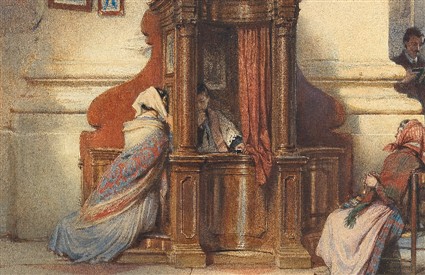
The Catholic church takes this verse to mean that the Apostles and their successors (bishops and priests) were given literal authority to absolve the believer's sins on Earth, which are then forgiven in Heaven.
Consider this...
If the apostles understood Jesus' words as giving them the authority to forgive sins I have to wonder why they never did so. There isn't a single instance in the Bible where any of the apostles including Peter forgave or retained anyone's sins. Much to the contrary, whenever they addressed the forgiveness of sins they directed their listeners to Jesus Christ.
Besides which in NO case was penance ever mentioned. Requiring penance for absolution is what humans believe is necessary.
Pentecost: Peter concluded his sermon on Pentecost (Acts 2:14-36) by replying to the question his hearers put to him which was "Brothers, what shall we do?”
Peter told them to do two things
Repent and be baptized, every one of you, in the name of Jesus Christ for the forgiveness of your sins, and you will receive the gift of the Holy Spirit. This promise belongs to you and your children and to all who are far off - to all whom the Lord our God will call to Himself.” (Acts 2:38-39 BSB)
There was nothing said about forgiving them their sins nor a word about penance. However, note Christian repentance does not mean just to feel sorry but to change one's mind and direction.
Cornelius
when Peter proclaimed the gospel to Cornelius and the others gathered with him that day, he did not say, "I forgive your sins in Jesus' name." Instead he told them that
And He (Jesus) commanded us to preach to the people and to testify that He is the One appointed by God to judge the living and the dead. All the prophets testify about Him that everyone who believes in Him receives forgiveness of sins through His name.” (Acts 10:42-43 BSB)
Stephen:
When Stephen was being stoned his last word were
"Lord, do not hold this sin against them.” And when he had said this, he fell asleep. (Acts 7:60 BSB)
He very apparently knew he did not have the authority to forgive their sins or would have done so. Much to the contrary, he asked the Lord to not hold this against them.
Simon the Sorcerer:
When Simon the Sorcerer tried bribing Peter and John to give him the power so that everyone on whom he laid hands on would receive the Holy Spirit." Peter's answer was that he needed to repent and pray for forgiveness
But Peter replied, "May your silver perish with you, because you thought you could buy the gift of God with money! You have no part or share in our ministry, because your heart is not right before God. Repent, therefore, of your wickedness, and pray to the Lord. Perhaps He will forgive you for the intent of your heart. (Acts 8:20-22 BSB)
Antioch :
Part of Paul's message at the synagogue in Antioch was
Therefore let it be known to you, brothers, that through Jesus the forgiveness of sins is proclaimed to you. Through Him everyone who believes is justified from everything you could not be justified from by the law of Moses. (Acts 13:38-39 BSB)
The Jailer:
In Acts 16 Paul and Silas were incarcerated when a strong earthquake shook the foundations of the prison causing the doors to fly open and everyone's chains to come loose. Seeing the open prison doors and assuming that the prisoners had escaped, the jailer was about to kill himself when Paul called out that they were still there. Then
Calling for lights, the jailer rushed in and fell trembling before Paul and Silas. Then he brought them out and asked, "Sirs, what must I do to be saved?” They replied, "Believe in the Lord Jesus and you will be saved, you and your household." (Acts 16:29-31 BSB)
They did not forgive him his sins but much like Peter on Pentecost focused on Jesus and the Gospel which caused him and all his household to believe and be baptized. (V. 33)
Proclaiming Vs. Doing
If you forgive the sins of any, their sins have been forgiven them; if you retain the sins of any, they have been retained.” (John 20:23 NASB)
In Scripture when the apostles and prophets proclaimed something they emphatically and authoritatively declared something that God had told them He would do. For example, God told Jeremiah that He had appointed him
... over nations and kingdoms to uproot and tear down, to destroy and overthrow, to build and plant.” (Jeremiah 1:10 BSB)
Jeremiah didn't physically do any of these things but was telling his hearers what God would do - he proclaimed these things in the name of the Lord.
There is a huge difference between proclaiming something and actually doing it. As is made evident in the above examples none of the disciples including Peter forgave or retained anyone's sins.
Jesus gave His disciples the authority to confidently proclaim the Gospel and tell people who believed that their sins were forgiven. In other words, they had the authority to proclaim forgiveness to those who repented and believed in Christ which they did many times over.
Similarly, we also have the authority to proclaim forgiveness of sins in Jesus' name to all who will believe.
On the other hand, on seeing the Holy Spirit was given through the laying on of the apostles' hands, Simon the Magician offered them money so that everyone on whom he laid his hands would receive the Holy Spirit. As Peter told him
"May your silver perish with you, because you thought you could acquire the gift of God with money! "You have no part or share in this matter, for your heart is not right before God. (Acts 8:20-21 NASB)
In other words, we also can proclaim to to that person that because their hearts are not right, they have no part in God's workings.
Finally - 1 John 1:9
What did John mean when he said...
If we confess (Gk. homologomen) our sins, He is faithful and just to forgive us our sins and to cleanse us from all unrighteousness. (1 John 1:9 BSB)
The Greek word homologomen is formed from a compound of the base of homou and logos; to assent, acknowledge. It is only used in the 1st person, almost always in the plural. The verb is in the present subjunctive and primarily refers to
on-going situations or habitually repeated events.
In other words the verse is saying that although our sins are forgiven at salvation based on what Jesus has done on the cross for us, our daily relationship with God needs to be kept in good repair. This is done by continually confessing our sin and asking for His forgiveness.
In his commentary on 1 John Pastor David Guzik elucidates further saying
Our sins are not forgiven because we confess. If this were the case - if forgiveness for a sin could only come where there was confession - then we would all be damned because it would be impossible for us to confess every sin we ever commit. We are forgiven because our punishment was put upon Jesus, we are cleansed by His blood.
However, confession is still vital to maintain relationship with God, and this is the context John speaks from. As God convicts us of sin that is hindering our fellowship with Him, we must confess it and receive forgiveness and cleansing for our relationship with God to continue without hindrance.
Confession must be personal. To say, "God, if we have made any mistakes, forgive us" isn't confession. [08]
Saying "if we made any mistakes" - The word "if" isn't specific. The word "we" isn't personal, and using the term "mistakes" isn't honest
End Notes
[01] What is the Sacrament of Confession. Catholics Come Home.org'
https://ya.catholicscomehome.com/your-questions/what-is-the-sacrament-of-confession/
[02] Why laypeople and deacons — in addition to priests — are necessary for a thriving Catholic Church. Saint Paul Seminary School of Divinity at the University of St. Thomas. https://tinyurl.com/2rjrrsjd
[03] https://www.britannica.com/topic/apostolic-succession
[04] What the Early Church Believed: Apostolic Succession. https://www.catholic.com/tract/apostolic-succession
[05] David Guzik. Study Guide for 2 Timothy 2
https://www.blueletterbible.org/comm/guzik_david/study-guide/2-timothy/2-timothy-2.cfm
[06] The Primacy Of The Successor Of Peter In The Mystery Of The Church. https://tinyurl.com/yn5nwskc
[07] David Guzik. Matthew 16 – Revealing Who Jesus Is and What He Came to Do.
https://enduringword.com/bible-commentary/matthew-16/
[08] David Guzik 1 John 1 – Fellowship with God. https://enduringword.com/bible-commentary/1-john-1/