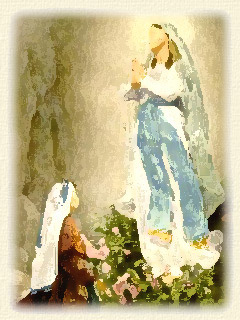
|
Also See Mary Who?
Mary's appeal is a growing phenomenon that has spread far beyond the traditional borders of Catholic and Orthodox Christianity. With many more shrines dedicated to her than even Christ, she is rapidly becoming the "queen of ecumenism" someone whom diverse religions can honor, rally around and even worship without offending their respective theologies. The Los Angeles Times reported that "A growing number of Americans from all Christian denominations are reaching out to the Virgin Mary as a comforting conduit of spirituality and a symbol of peace in troubled times ...It's not just Catholics who are interested in Mary and following the apparitions.
The Real Mary of The Bible
We know the Mary of the Bible was obedient to God's call to the point she was willing to risk her life as well as her future marriage and be the topic of slanderous gossip. She had faith to believe the impossible, pointed people away from herself to the teachings and directives of Jesus and mourned at the foot of the cross. She was also one of the over one hundred people who waited in the upper room for the Holy Spirit. In spite of all the above there is much more information in Scripture about other servants of God such as Moses, Abraham, the apostle Paul, etc. Additionally, She did not author any of the Bible nor was she martyred for her faith...
ON THIS PAGE
Delusions
The Healing Aspect
Ecumenism, Syncretism and the anti-Christ
Too Much of Everything
Medjugorje, the Charismatic Movement and the Hercegovina Case
"By their fruits"
The Visionaries
The Mother of God or the Goddess?
The Messages
Delusions
Why is it that these apparitions are accepted so readily by the visionaries themselves and by countless pilgrims? Heterodox Christians have very little idea of one of the key concepts of Orthodox ascetical teaching prelest - spiritual deception - whereby a mirage is mistakenly accepted for truth.
There are many examples in the Lives of the Saints where monastics and ascetics, many of whom went on to achieve genuine holiness, fell into delusion, entertaining demons in the form of angels, and even "Christ" Himself, receiving "revelations," seeing "light" in their cells and hearing "the Lord" speaking to them. Sometimes "Christ" granted them gifts of "prophecy' and astonishing powers. St Diadochus of Photiki warned against accepting the deceit of the evil one under the form of light or some fiery form, and St Symeon the New Theologian warned of evil spirits who cause many and various deceptions in the air.
Imageless prayer, as taught by the ascetics and elders of the Orthodox Church, is in direct contrast to that of, for instance, a person seeking help from a Protestant Healing Mission, who may be told at the prayer session preceding the healing service to imagine a golden light streaming down on him from heaven, and to the meditation practices common in the West for centuries, whereby one was encouraged to imagine a chosen scene and try to visualise the Child in the manger or the Crucified Christ. St Mark the Ascetic warns that "Once our thoughts are accompanied by images, we have already given them our assent."
This image-producing faculty may, in the spiritually advanced be used creatively, as in the iconography of St Andrei Rublev and devout iconographers generally, but time and again we are warned that those not yet possessing spiritual discrimination should beware of being enticed and led captive by illusory appearances.
What many Marian apparition enthusiasts do not realise is that spiritual phenomena are almost commonplace these days. The Pentecostal / Charismatic groups are very quick to identify their experiences with the Holy Spirit, just as the Protestant revivalists in Indonesia in the 1970's unquestioningly accepted their "voices," "angels" (invariably quoting Scripture by chapter and verse), visions of "Christ," healings, miraculous lights accompanying evangelists, and mysterious fires from heaven that consumed Roman Catholic statues, as genuine. People who bring "Christian" ideas to their experiences often assume, all too readily, that they actually are Christian experiences, the work of the Holy Spirit, and they seldom pause to ask if they might possibly originate from quite another kind of spirit.
IPS Note: See for example the Literal Doctrines of Demons in The Modern Church -
Slain in the spirit and Tongues in particular.
Even when these experiences are genuinely Christian, the words of a saint of the Roman Catholic Church, John of the Cross, sound a timely warning:
"All visions, revelations and impressions of heaven, however much the spiritual man may esteem them, are not equal in worth to the least act of humility; for this brings forth the fruits of charity, which never esteems or thinks well of self, but only of others."
The Cure d'Ars did not accept the La Salette visions, the ecclesiastical authorities at Garabandal were unimpressed, and the former Roman Catholic bishop of Mostar denounced the Medjugorje apparitions. Certainly some of the visions would appear to be initially the result of psychological factors. Most of us do not have a strongly developed sense of self-awareness. We know very little about ourselves and have little understanding of the mysterious, but entirely natural, workings of the sub conscious mind and the effects it can produce. Apart from self-delusion, there is a possibility of unconscious mediumistic participation or even more direct demonic delusion.
If Bernadette, waving her rosary at "Aquero," and the Medjugorje youths clutching their holy water jars and admonishing "the Gospa," "If you are satan, go away," really suspected the presence of a demon, they surely seriously underestimated the power they were dealing with. "Jesus I know, and Paul I know, but who are you?" (Acts 19:15). The aged God-bearing Elder and Confessor of Mount Athos, Fr Sabbas (+ 1908), when asked to deliver a monk possessed by a demon, prayed and kept a complete fast for a week before doing so, and delivered another monk who had been deceived by a false "guardian angel," who had prayed and spoken with him daily for two years, by prostrating himself as "with pain and tears he prayed to the Lord to take pity on His servant and rebuke the evil demons."
IPS Note: Most commonly associated with the 1981 reported apparitions in Medugorje, Bosnia "Gospa" is Croatian for "Madonna" or "Our Lady," referring to the Virgin Mary.
More About Medjugorje on THIS Page under the heading ‘Apparitions’
Staretz Amvrossy of Optina, who as a great monastic [and] spiritual guide, was frequently asked for advice on visions and voices, relied on the basic teaching of the Fathers, and warned those who sought his guidance on such matters not to trust in voices heard during the time of prayer or in changes in the icons - fragrance or fiery flames coming from them - which might seem to be good, but to attach no significance to them as such things also come from the deceit of the enemy.
In a question and answer session with a Franciscan, one of the Medjugorje "seers" was asked why Ivanka, the girl who first saw the apparition, said at once, "It's the Blessed Virgin." The reply was, who else could she have thought of? A wonderful young mother with a child and a crown on her head. It was clear." The apparition was accepted unquestioningly as being the Virgin and was spoken with before any throwing of holy water (advised by the older women of the village) was resorted to. "My angels," as the apparition repeatedly called the young people, asked for a sign, and the vision obligingly made the hands turn on the watch of one of the visionaries.
At Ivanka's last vision on May 7th, 1985, the Gospa, in answer to Ivanka's request, caused the girl's mother, who had died some months before the apparitions began, to appear. "Our Lady asked me what I would wish and I asked to see my earthly mother. Then Our Lady smiled, nodded her head, and at once my mother appeared. She was smiling. Our Lady said to me to stand up. I stood up, my mother embraced me and kissed me ... She then spoke to Ivanka and disappeared.
Complete trust was given by the young people to the apparition of Medjugorje, a trust that would be encouraged by the Franciscans, who acted as their confidants and spiritual directors. There was no concept of pretest, there seemed to be no recognition of the fearful darkness of the fallen mind. The same argument used to support the authenticity of Medjugorje - "the tree is known by its fruits" - fervent prayer, conversions, healings, sense of peace and joy - has been used by "Charismatics," Protestant Revivalists, the Evangelicals in Indonesia, and various heretical movements throughout history.
Hindus and Buddhists doubtless say the same thing as they point to the intense devotion of their own followers on mass pilgrimages to the temples, and the reported healings at the shrines of their own holy men.
St Ignaty Brianchaninov, in his warning to Orthodox Christians, reminds us of the frightful danger of being deceived by evil spirits. "If the saints have not always recognized demons who appeared to them in the form of saints and Christ Himself, how is it possible for us to think of ourselves that we will recognize them without mistake! ... The holy instructors of Christian struggle ... command (us) not to trust any kind of image or vision if they should suddenly appear, not to enter into conversation with them ...
" but in resolute awareness of one's unworthiness and unfitness for seeing holy spirits, to entreat God that He might protect us from all the nets and deceptions, which are cunningly set out for men by the spirits of malice." ... "The only correct entrance into the world of spirits is the doctrine and practice of Christian struggle. The only correct entrance into the sensuous perception of spirits is Christian advancement and perfection."
The Healing Aspect
Some people assume that the apparitions must be genuine because cures take place at the shrines, but there is not necessarily any connection between the two. The number of cures is actually very small considering the multitudes of sick people who flock to the shrines. At Lourdes, in the one hundred and twenty-two years from 1858 to 1980, only sixty-four cures were finally pronounced miraculous - that is, not attributable to any known natural or medical cause - out of a possible five thousand. While the medical authorities naturally need to be cautious, it does seem somewhat artificial and presumptuous for a group of human beings to solemnly declare that God has not only performed a miracle, but has performed it properly, to their satisfaction.
At several shrines the Virgin was reported as saying that she would heal some, but not others, and to read that "the finger of God would flash down unpredictably" somehow introduced a certain element of capriciousness which was disturbing, however much one might want to rejoice at the cures themselves. But the Marian shrines are not alone in claiming healings for people of all faiths and of none, although they tend to get the most publicity. The Anglican London Healing Mission lists many astonishing cures every month, the Pentecostal / Charismatic groups also claim cures, as do Spiritists (The National Federation of Spiritual Healers), and, in its heyday, the Christian Science movement had an impressive healing record.
It is said that no-one is infected by bathing at Lourdes, but there is no record kept of infections, and, in any case, people in seventeenth and eighteenth century England were exposed to the same risk in the fashionable spa waters (Samuel Pepys at Bath had grave doubts about the wisdom of using the waters), yet there were no recorded outbreaks of typhoid or cholera. The authorities at Lourdes know that they cannot risk an outbreak of infection or the baths would have to close, and healthy pilgrims are encouraged to wash at the taps instead of bathing. It is interesting to note that Bernadette herself did not use Lourdes water for her own ailments, but sought relief at the nearby spa instead.
God works in different ways as He sees fit, and it would be foolish to attempt to impose limits on His mercy, but Orthodox Christians themselves do not need to seek healing outside the Church. We have always known wonder workers and healers. Staretz Amvrosy, mentioned earlier, was a healer, as were countless others, and innumerable healings continue to take place at the intercession of the Mother of God, for instance through her Tinos and Malevi icons, and at the intercession of St Xenia of Petersburg, and of St John (Maximovitch) of Shanghai and San Francisco.
Many non-Orthodox would be very surprised if they knew how often healing of the body is mentioned together with the healing of the soul in the Church's prayers. In the prayers of Preparation and Thanksgiving for Holy Communion particularly, we pray repeatedly for "the healing and purification and enlightenment and protection and salvation and sanctification of soul and body," and for the Divine Grace to fill our five senses, joints and bones, as well as our mind, soul and affections. Likewise, the service of Holy Unction has never been kept solely for the dying, but is held on the eve of Christmas and on the Wednesday in Holy Week, when all the faithful are anointed, and anyone may request a service at any time in case of need.
Some people emphasize the great compassion shown for the sick at Lourdes, and the time and energy spent on their behalf year after year by devoted helpers, and feel that the visions must be true if so much good comes from them. But compassion is not a solely Christian prerogative.
Compassion to every living creature is the hallmark of Buddhism, and plenty of people of all faiths and none are quietly doing unpublicized voluntary work in hospitals or among the mentally and physically disabled in their neighborhoods. The healings and compassion are not proof of the authenticity of the apparitions. That cures take place is not in doubt, but the exact nature of a cure may vary from case to case, and since both Protestant and spiritist bodies also show tangible results, it would be unwise to accept unreservedly the religious implications of cures at the Marian shrines and invest them with an interpretation that they cannot logically be made to bear.
Ecumenism, Syncretism and the anti-Christ
As the apparitions have been manipulated by various interested parties for the purposes of Roman Catholic propaganda, proselytism, nationalism and commercialism, so they are eagerly taken up by supporters of ecumenism. Anglicans, Lutherans, even Orthodox all visit the shrines. "The Madonna is for everyone." Or, "Come into my parlour, said the spider to the fly"? Just as the Pope has spoken of the "conversion of Russia" under one shepherd, "the successor to St Peter," so the Vatican's unchanging reunion plan for the rest of us is an open secret - subjection to the Roman Pontiff.
At the same time, ecumenism beyond Christianity continues to gather pace in "the dialogue with non-Christian religions," although honest dialogue does not appear to be what the WCC has in mind.
"The great religious communities will not disappear... Jews will remain Jews, Moslems will remain Moslems, and those belonging to the great oriental religions will remain Hindus, Buddhists and Taoists" - yet somehow everyone, still keeping to his errors and rejecting Christ, "will abide in the Kingdom of God without ... having first become Christians like us."
God cannot be contained, and He is the source of whatever truth is present in other faiths, but as C. S. Lewis pointed out, being a Christian does mean thinking that where Christianity differs from other religions, Christianity is right and they are wrong. He used the illustration of a sum - there is only one right answer to a sum, and all other answers are wrong, but some of the wrong answers are much nearer being right than others.
Marian ecumenists believe that the Virgin is bringing an ecumenical message at Zeitoun and Medjugorje and that as mother of the entire human family she has a special role to play as a centre of unity and reconciler of quarrelsome children, so to speak. They point out that at Zeitoun the Mother of God remained silent. This is interpreted as a gesture of motherly tact and an invitation "to everyone present, regardless of their beliefs, to unite in God through prayer" (which is now quite normal at meetings for "dialogue with non-Christian religions" and in keeping with the ideas of the WCC). Had she declared herself to be the Mother of God, the Moslems would have rejected the vision; and had she identified herself as the Immaculate Conception, the Coptics would have rejected it. They emphasize that the Virgin is mentioned in the Koran as the chosen of Allah and her purity and virtue extolled, but they omit to follow this by stating that Christ Himself is regarded as no more than one prophet among others - and inferior to Mahommed - and that His Crucifixion and Resurrection are utterly rejected.
An Anglican correspondent for the Eastern Churches Review described his visit to Zeitoun in the Spring 1970 edition. He related the story of a leading Moslem who lived near the church and used to throw stones at the pilgrims. The Virgin appeared to him, requested that the stone-throwing cease, and ordered him to paint the cross on his house. This convinced him of the authenticity of the visions and he painted forty large white crosses all over the walls of his house. Somehow this seems a rather pointless exercise, as the man remained a practising Moslem and did not turn to Christ, Who seems not to have been actually mentioned and who, as usual, seems strangely absent from the proceedings.
At Medjugorje the Virgin announced that she had come to "convert and reconcile." The shrine is seen as a possible key to peace in the region as only the "Gospa" can reconcile Catholics, Orthodox and Moslems, since they all reverence her. Once again we encounter this extraordinary idea of reconciliation and unity without Christ. The Gospa has chided Catholics of the region for mocking their Orthodox and Moslem neighbours, although this has not curbed anti-Serb propaganda in some of the books about the Medjugorje apparition.
She has declared that "basically religions are similar," which sounds very much like the teaching of Swami Vivekananda, the late nineteenth, early twentieth century Hindu missionary to the West, who said that all religions are the same at heart. The foundation and heart of Christianity is the Holy Trinity and the Resurrection of the God-man Jesus Christ. Judaism and Islam also believe in a God who requires men to live in a "good" way and oppose "evil," while Hinduism, as far as I can understand it, believes that God is beyond "good" and "evil," that everything in this world is part of God, that if only we could see things from the divine point of view, we should see that things we call bad from our own limited human viewpoint are also "God."
Swami Vivekananda, speaking of the goddess Kali, the Terrible Mother, who unites opposites within herself - life and death , creation and destruction, mercy and terror - said, "Who can say that God does not manifest Himself as Evil as well as Good? But only the Hindu dares worship Him as the Evil." All religions share some things in common, but there are fundamental differences.
The Gospa has also said that the Pope is to be a father to all people, not just to Catholics. Pope John Paul II, who is said to believe in the apparitions, seems to have taken her sayings to heart and made them the inspiration for further ecumenical moves. Apart from his Assissi World Day of Prayer, he refers to the Jews as the older brothers of Christians and, in his speech to young Moslems in Morocco, referred to the Father God sixty-six times. This in addition to the Vatican "missionary campaign" in Russia and the Ukraine, and Vatican interference in the Balkans, in Croatia, Bosnia and Skopje. The Pope apparently sees the third millennium as a new time for mission, a new era of faith, and has given his support to "Evangelization 2000," which has plans for world-wide evangelizing activity, with Europe, West and East, a priority. All these are
"signs that indicate not only the gathering of Christians, but the embracing of all faiths and cultures within a common human identity before God" (Dudley Plunkett: Queen of Prophets).
Archbishop Frane Franic of Split says, "... I especially see the importance of the role of Medjugorje in the ecumenical work of the Church."
Might it be that the visionaries of Medjugorje are being used (albeit unconsciously) as part of a much wider softening-up process to prepare the way for the setting-up of a universal world religion in preparation for the coming of the Anti-Christ? It is, after all, of the essence of subtle demonic deceit to make things appear good and Christ-like, to present the kingdom of satan as if it were the Kingdom of Christ. The eighteenth century Anglican divine, Samuel Horsley, would grieve to see his words coming true today: "The Church of God on earth will be greatly reduced ... in the time of Anti-Christ, by the open desertion of the powers of the world. This desertion will begin in a professed indifference to any particular form of Christianity, under the form of universal toleration ... from toleration of the most pestilential heresies, they will proceed to toleration of Mahometanism and Atheism, and at last to the positive persecution of the truth of Christianity."
Meanwhile, the earlier fifteenth century Cardinal Nicholas of Cusa would rejoice at the prospect of his vision in which he saw "warring sects permanently reconciled in a vast system of religious unity," wherein "pagan and Christian are jumbled up in a remarkable order, ... a Greek, an Italian, a Hindu, an Arab, a Chaldean, a Jew, a Scythian, a Persian, a Syrian, a Spaniard, a Tartar, a German, a Bohemian, and finally an Englishman," because "each system possesses a certain degree of truth" and "only through a study of the various systems can one have an inkling of the 'unity of the unattainable truth'."
If there is an Anti-Christ aspect at Medjugorje, it would fit in well with an increasing interest in signs and wonders. The supernatural has been largely removed from life by rationalism, materialism and intimidation by science and technology. An increasing number who feel this lack have tried to fill the gap with UFOs, dancing suns, drugs, "faith" healing, charismatic revivalism, spiritism, New Age paganism, even satanism - and apparitions. Superstition continues to flourish. A statue of the Virgin weeps blood from one eye, and the neighbours pour in to recite the rosary before it. (In the opinion of the manufacturers, the resin used to fix the eyes had probably melted - quite a frequent occurrence.) A Mexican woman fries a tortilla for her husband's supper, sees it take on a resemblance to the face of Christ crowned with thorns, and a miracle has taken place! Over the following twelve months, 8,000 people have venerated the batter, encased in glass and surrounded by flowers and candles, while an embarrassed Archbishop tries in vain to halt the holy pancake cult.
Thousands of people make a sober claim to having had their lives spiritually transformed by the shrines. Traditionalist Catholics, especially Marians, see the shrines as confirmation of their faith. Waverers who have been shaken by modern liberal changes in Catholicism seek and find reassurance. Liturgical innovationists feel free to indulge in services with "increased amounts of spontaneity and informality," such as the Party Mass for sick children at Lourdes, where following the consecration, balloons and streamers filled the air, and the celebrants joined hands and skipped up the aisle singing "Lord of the Dance" (actually the Hindu god Siva). Some nuns continue to live the old life, but most of the Sisters of Charity of Nevers (Bernadette's order) have put aside the religious habit and become part of the modern world. Even Bernadette herself has been manipulated by different groups who claim her as their heroine - the "revolutionaries" of Christ the Worker, because she was poor, working-class and generally disadvantaged; the "charismatics" because she had visions and heard the voice of heaven directly, apart from the official hierarchy.
Spiritual power-houses, places of hope and healing, an outlet for superstition, a paradise for petty thieves (according to Patrick Marnham, a large plain-clothes police is required at Lourdes in high season) and commercial exploiters, a boost for tourism, an excuse for nationalism and proselytism, a way of satisfying the recurrent popular demand for the Goddess under a respectable Christian guise - the Shrines seem to be many things to many people.
Too Much of Everything
I conclude as I began by emphasizing that this a purely personal view of the apparition events. That one or more of the factors considered has played some part in each case I have no doubt, but beyond that I will not venture. Everyone is entitled to his or her own opinion, to accept or reject the apparitions, to visit the shrines or to stay away, but any Orthodox who might consider seeking healing at these shrines or going on pilgrimage there to honour the Mother of God, should, I believe, give very careful consideration indeed to what these places are all about.
The Russian Orthodox priest, Fr Sergius Bulgakov, after his own pilgrimage to Lourdes, wrote:
"The remembrance of this place embalmed by the presence invisible to our eyes, but clearly perceptible to our souls, of the most holy Mother of God, ...will remain among the dearest memories of our lives. At least in our hearts the interior dividing wall which separates us from the Roman Church has lost much of its opaqueness."
Everyone's experience is his own, but this should be balanced by that of the Roman Catholic Robert Hugh Benson, quoted earlier, who experienced the dark side of the Lady of the Grotto. It should, perhaps, also be borne in mind that Fr Sergius' sophiology, considered very suspect by Orthodox theologians like St John (Maximovitch), may have affected his experience - "the Holy Spirit is manifest through the Virgin Mary - she is a creature but also no longer a creature." Contrary to what some Orthodox, including priests, have been led to believe, there is no Orthodox chapel at Lourdes.
It is not obligatory for Roman Catholics to accept the apparitions even when their church has approved them, although some Marianists would like this changed, saying that official approval goes beyond permission to believe and involves infallibility.
After a great deal of serious thought, I am unable to accept a divine origin for any of the apparitions (although some may very well be supernatural in origin), or to believe that God is speaking to the world through them. As an Orthodox, they seem to me unnecessary. We have the Scriptures, the teaching of the Church and the accumulated spiritual wisdom of 2,000 years to guide us. Above all, we have the Holy Spirit as the Pilot and Guide of the Church, and the Lord Jesus Christ as the ever-present and only Head of the Church. With the exception of Zeitoun, the apparitions have all appeared within a church which has pushed the God-man back into heaven and appointed a man as His infallible vicar on earth, a man whose position and power are reinforced and extended by these visions. The great Serbian theologian, [Archimandrite] Justin Popovich [of Blessed Memory], commented: "Vicarius Christi - what tragic illogic: to appoint a vicar and representative for the omnipotent God and Lord."
For me, there are simply too many visions. The psychologist Staehkin, mentioned earlier, investigated over thirty sets of apparitions of the Virgin, involving three hundred appearances, between 1930-1950. Apart from the Miraculous Medal, which seemed to spark the whole thing off, and the apparitions already mentioned, we have also had Akita, in Japan (where a nun saw sheets of light in her cell and had over a hundred visions in which a statue of the Virgin spoke, wept, and bled), Rwanda, Argentina, Nicaragua, Venezuela, Korea, Hungary, Belgium, Holland, the USA, China, Syria, the Philippines, Italy and Ireland. Forty-seven other visionaries appeared outside Medjugorje in other parishes in the Mostar diocese.
It is not the experiences that are in doubt, but the origin of the experiences, as visions may be caused by various psychological factors, natural psychic and mediumistic ability or demonic delusion. The demons do not hesitate to make full of our fallen intellects, false assumptions, spiritual pride, and psychologically based delusions, which is why the Church warns us, through the ascetics and great spiritual fathers, to be spiritually sober and constantly aware, lest self-deception turns into demonic deception.
There are too many solar signs. Ever since Fatima, solar phenomena have been a feature at most of the shrines - lights, fires, rainbows, dancing suns, showers of petals, fiery crosses, with a particularly dramatic display at Zeitoun. When to these are added the Protestant Revivalist signs - pillars of fire, "Christ" in the sky, clouds that follow evangelists and shelter them from heat, and all the earlier UFOs, one cannot help wondering if there is a programme afoot purposely geared to cater for a generation that seeks after signs - the demons obligingly providing what we are ready to receive. One or two visions and signs might be convincing, but not literally hundreds.
The apparitions are too public. Private revelations are one thing, but most of these apparitions have taken place amid a surfeit of publicity. The "heavenly" visitor comes with a global message and the visions frequently take place in front of crowds of spectators. The visionaries have frequently been the centre of a most unhealthy amount of interests and adulation. The Grotto at Lourdes was filled with police, the police commissioner, the mayor, his deputy, and crowds of up to 20,000. Bernadette was constantly taken from lessons for questioning, waylaid in the street and pestered by the crowds which besieged her home, anxious to catch a glimpse of her and ask for keepsakes and prayers. Similar crowds followed the Fatima children, kneeling to them and begging them to enter their homes and pray for sick relatives. Even Lucia's plaits were snipped off in the crush by relic hunters. The Zeltoun visions were seen by millions, believers and unbelievers alike.
Amid the full glare of modern publicity, the Medjugorje visionaries quickly became the centre of world-wide attention, giving advice to those who crowded to their homes and relaying answers from the Lady of Medjugorje in response to questions from the crowd. They have been interviewed endlessly and investigated by doctors and psychologists. The Medjugore events have been promoted by an efficient and aggressive propaganda campaign using every possible means: printing presses dealing solely with the events, international dial-a-numbers for those wishing to receive the Gospa's monthly message, world-wide radio and TV programmes and lectures, videos, cassettes, and numerous books. (The mariologist Rene Laurentin alone has written at least ten.)
One of the visionaries is co-author of a book, A Thousand Encounters with Our Lady in Medjugorje; another, via the American Ambassador to the European Community, wrote to Ronald Reagan and Mikhail Gorbachev (Reagan replied).
There are special Medjugorje Centres across the world. And all this before any official decision on the apparitions has been reached by the appropriate ecclesiastical authorities. It seems doubtful whether any commission will finally be prepared to give a negative verdict in view of the highly successful propaganda and the degree of popular religious enthusiasm, especially as the Pope has said he thinks there is nothing but good at Medjugorje.
More About Medjugorje on THIS Page under the heading ‘Apparitions’
Medjugorje, the Charismatic Movement and the Hercegovina Case
While reading about the Medjugorje events I was struck by certain similarities with the Charismatic Movement, especially in the messages and attitude of the supporters, so it came as no surprise to find that almost from the beginning the events of Medjugorje were in the hands of charismatic people: Friar Jozo Zovko, Friar Tomislav Vlasic and others, or to learn that
"In May 1981, an international conference for the leaders of the Charismatic Movement took place in Rome. One of the leaders present from Yugoslavia was Fr Tomislav Vlasic.... One of the leaders praying with him, Sister Briege McKenna, had a mental vision of Fr Vlasic sitting down surrounded by a big crowd: a stream of water was flowing from the chair. Emile Tardif, O.P, said as a prophesy, 'Don't worry, I am sending you my Mother.' And so Fr Vlasic returned to Yugoslavia. Two weeks after his return, Our Lady started to appear to a group of boys and girls in the Franciscan parish of Medjugorje. New Life was flowing."
The Father Vlasic mentioned was the spiritual guide, interpreter and protector of the visionaries for three years. To some he is "a man of irreproachable sanctity," to others "a Charismatic magician."
There is the same incredible ease with which the visionaries accept their apparitions and the charismatics accept their "gifts of the Spirit" as coming from God. Something that is not mere hallucination, but is outside the limits of human knowledge and experience, is still not necessarily a genuine, grace-given vision. It can be simply a trust in pleasant psychic experiences. There is also the same emphasis on "love" and "peace" and "joy" in the messages.
Here there would appear to be similarities with another phenomenon spiritism. Mediums do not hesitate to accept their spirit guides as Messengers of Light, and their messages, too, are invariably loving and consoling, usually reverent, with frequent references to a Deity, and with moral teaching. Mediums claim to convey messages from a higher world. The visionaries have conveyed messages from the Gospa to those who have sought answers through them. Even the Archbishop of Split asked one of the visionaries if she could ask the Gospa if there was any message for him.
A charismatic, speaking of the prophesies in her American meeting, says, "The messages have always been those of great solace and joy from the Lord." A Medjugorje supporter, speaking of the Gospa's messages, says, "The messages are a mine of beautiful counsels and reassurances."
"I reach out my hand to you. You need only take it and I will lead you" (Charismatic). "Today I want to wrap my mantle around you and lead you all along the road to conversion" (Gospa). "Be like a tree, swaying with his will, rooted in his strength, reaching up to his love and light" (Charismatic). "Open your hearts to God like the flowers in the Spring yearning for the sun" (Gospa).
Obviously the healing services at Fr Jozo Zovko's church, mentioned earlier, were charismatic ones, which explains why the people fell about embracing, weeping and fainting. Fr Jozo's ministry now includes Resting in the Spirit - a less dramatic version of the Pentecostal / Charismatic Slaying in the Spirit - to which he was introduced by an American, and which has apparently caused "some embarrassment" in the parish. See Slain? ... By What Spirit? Chapter 4 in particular
Conflict with the Franciscans in Hercegovina stretched back to Turkish times, when the friars continued to minister to the Catholics in the absence of a bishop. In 1881 a regular hierarchy was reestablished, the intention of the Holy See being that secular clergy would gradually replace the Franciscans in charge of parishes. This caused deep resentment and tension between the friars and the people on the one hand and the diocesan authorities on the other. Medjugorje remained a Franciscan parish.
Dr Zanic, the Bishop of Mostar at the time of the apparition beginnings, continued to implement this policy in the face of widespread opposition. Two friars openly rebelled and were jointly suspended by the bishop and expelled from their order by their own superiors. The two friars promptly enlisted the help of the visionaries who referred the matter to the Lady of Medjugorje on no less than thirteen occasions. She came down firmly on the side of the two friars innocent, blameless, and punished in this way! ...
The Bishop does not act according to the will of God ... The Bishop has been hasty ... The Bishop is guilty." "She (the Gospa) spoke about this (Hercegovina) case and burst our laughing and said that she alone would sort out everything. Then she began to laugh. Then Jakov and I had fits of laughter..." "If he (the Bishop) doesn't accept these events (the authenticity of the apparitions) and behave properly, he will hear my judgement and the judgement of my Son."
The Bishop (and others) remained sceptical, calling the whole thing a deceit and swindle and claiming that a group of friars led by Fr Tomislav Vlasic were exploiting the "Visionaries" for their own ends.
"By their fruits"
The supporters see in Medjugorje a great stirring of religious renewal and are wildly enthusiastic, while others, both clergy and laity, even families from the village remain indifferent or opposed.
The supporters bring out the usual argument, the same one used for all shrines, as well as by heretics of the past, and the charismatics, both Catholic and Protestant, today. "By their fruits ye shall known them." They ask how Satan can be at work when the vision emphasizes prayer and fasting, and when there are conversions and healings.
Dr Franic, Archbishop of Split, uses this argument in a letter to Rome in 1985, writing: "For the last three and a half years over three million pilgrims have come to Medjugorje, from all five continents, and all, after the pilgrimage, have returned home converted or brought back to the Christian life from religious indifference or from absolute atheism, renewing contact with prayer and religious practices like fasting, generally on Friday, and in some homes also on Wednesday, their food consisting of bread and water, in a word completely reconciled with God and men."
That most returned home in a state of temporary euphoria is very likely; that some, perhaps a good many, began to live a more serious Christian life and came face to face with Christ for the first time is certainly possible, but that all three million - if there were three million to start with - were completely reconciled to God and men would indeed be a miracle, the miracle of Medjugorje, but it is much more likely to be wishful thinking on the Archbishop's part. We only have to recall the Parable of the Pharisee and the Publican to know that prayer and fasting or any other "religious practice" are not sufficient in themselves to reconcile us to God and men.
Healings, as we know, occur in many places other than Marian shrines, also in non-Christian religions. Healing, like the numbers of pilgrims, has been cause for dissension, with opponents claiming that there is no proof for many of the healings, that the Medical Bureau at Lourdes gave a negative response, and that some of those claimed as "healed" had in fact died. At one pilgrimage, the Bishop of Mostar declared there were only 30,000 pilgrims as against Fr Vlasic's possible 200,000. The visionaries asked "Our Lady of Medjugorje" for the precise number. She replied 110,000.
There are also rotten fruits - the disagreements with devotees of other Marian shrines (echoes of Our Lady of Walsingham versus Our Lady of Ipswich), and another sorry saga of dog-collar-eat-dog-collar, again with exceedingly acrimonious exchanges at high levels. On a lighter note, Desmond Seward (The Dancing Sun) gives us an amusing account of the lengthy sermon at an English mass by a priest from Kentucky, which included a moving account of his agonies in giving up Coca-Cola after he had responded to the Virgin's call to do penance.
The Visionaries
How convincing are the visionaries themselves, who all believe that they have seen the Mother of God? A real cause for concern is what would appear to be an extraordinary lack of spiritual caution, resulting in unquestioning acceptance of their visions as indeed the Blessed Virgin. Recall the words of one Medjugorje visionary - "Who else could it be? It was obvious!"
Zeitoun stands out as a different from the other apparitions because, as mentioned earlier, the figure was seen over three years by senior members of the Coptic clergy, Catholics, Protestants, Moslems, Jews and atheists. Had it not been for the striking similarity between the descriptions of the Zeitoun solar phenomena and the earlier descriptions of UFOs, I would have found this group of witnesses solid and impressive, although it would still have been difficult to see why the Virgin should appear in this public way to all and sundry, when Christ Himself never took the opportunity to convince unbelievers by appearing over Jerusalem, where He could have been seen by Pilate, Herod, Calaphas, and all the people, as proof of His Resurrection.
Catherine Laboure, who saw the Miraculous Medal, was a lover of visions, and embarked on the unwise (in Orthodox eyes, exceedingly dangerous) course of seeking more visions. Knowing how the demons can deceive us, the ascetics always spurned visions, saying that they were unworthy to see angels. The Miraculous Medal prayer proved excellent propaganda material for the Immaculate Conception dogma, and Catherine died knowing that millions of medals had been distributed throughout the world. Her own identity, which was supposed to have been kept a secret, was somehow discovered, and she was canonized by the Roman church.
Maximin and Melanie of La Salette seem to have been an unprepossessing pair as children, and their adult lives were not very reassuring either. Bishop Doupanloup found Maximin "disgusting in every way," and the cure d'Ars, who also interviewed him said, "If what the child tells me is true, one cannot believe in it." However, the voice of popular enthusiasm prevailed and the official conclusion was in favour of the apparition.
Bernadette comes across as refreshingly normal, with plenty of rough peasant wit and common sense. After entering a convent she had no further visions and did nothing to draw attention to herself or engineer the fame she was to acquire. Her physical illnesses were suffered courageously and borne with dignity. She apparently believed that she had never willed to do anything wrong in her life, and she also believed that she had never [previously] heard the words "Immaculate Conception."
The latter is almost impossible to accept because the people of the Pyrenees had been celebrating the Feast of the Immaculate Conception as a holy day of obligation for the previous one hundred and fifty years, that is, since the decree of Clement XI in 1708. (Plus IX merely defined the dogma and imposed it as an article of faith.) Throughout her Catholic childhood in a Catholic culture, Bernadette would have been taken to church on 8th December, just as she would have gone at Christmas, Easter and the Assumption. After the definition of the dogma in 1854, and in connection with the popular Miraculous Medal, with its prayer to "Mary conceived without sin," the Immaculate Conception must have been referred to countless times in her hearing.
The small seers of Fatima were paragons of virtue according to Sister Lucia, the surviving visionary, with a chillingly unnatural brand of piety. They wore ropes round their waists, next to the skin, until their Lady assured them that God did not wish them to sleep with the ropes on, but only to wear them during the day. They mortified themselves in every possible way, at times refusing food and drink, and deliberately stinging themselves with nettles, and they made a sacrifice of absolutely everything, saying each time the words the Lady had taught them: "O Jesus, it is for love of You, for the conversion of sinners, and in reparation for the sins committed against the Immaculate Heart of Mary." The two younger seers both died in childhood; Lucia continued to receive visions and revelations as a nun.
Marlette Beco, a Belgian girl, was visited eight times in 1933 by an apparition who bore an uncanny resemblance to the Lady of Lourdes, who likewise asked for a chapel, produced a spring, and gave the child a secret. Marie was eleven years old, at an emotional pre-adolescent age, and was frequently reduced to tears on account of the apparitions, crying during some of the visions and "weeping uncontrollably at the non-appearance of her Lady" on evenings when nothing happened, and feeling ill and tired and fainting, although the doctor declared that there was nothing physically wrong with her.
At the end of the final apparition, at the departure of the "Virgin of the Poor," the girl "flung herself to the soggy ground where she lay in a crumpled heap, hiccuping and sobbing convulsively, while attempting to say her prayers." Marlette Beco was recognized by the ecclesiastical authorities as having seen the Blessed Virgin, and Banneux blossomed into a pilgrimage centre with the usual parade style ground for blessing the sick, a hospital and camping area. A society of Banneux organizes pilgrimages and disseminates information.
The young people of Medjugorje have been described as living in an exalted spiritual world, shining examples who live "exemplary lives of prayer, fasting, detachment from the evil of their age and peers manifesting true love towards the Church and the Pope." They have also been called "little liars," "ignorant pawns in a game they do not understand," with "inflated egos" and behaving like "domesticated robots."
More About Medjugorje on THIS Page under the heading ‘Apparitions’
One visionary, Mirjana, no longer sees the apparitions but instead hears an internal voice. Two other girls (other than the visionaries), Jelena and Marijana, initially under the direction of Fr Tomislav Vlasic - the charismatic leader who had been spiritual director to the visionaries - also hear an inner voice, which they believe to be the Virgin's, giving them personal messages, messages for the local prayer group, the parish and the world.
Over a million copies have been distributed free of books by the same Fr Vlasic which contain meditations on the messages and include "formulae of consecration to the sacred Heart of Jesus and the Immaculate Heart of Mary, dictates by Our Lady to Jelena." Other priests associated with Medjugorje and the Charismatic Movement also receive "inner locutions," said to be an explicit internal awareness of a message unlike any human form of communication.
Lest anyone should hesitate to accept the apparitions on account of their doubts about the visionaries, they need not worry, Rome has the answer. A special category of divine favours to cover unsatisfactory visionaries - "gratiae gratis datae" - favours given by God with no regard to the spiritual state of the visionary.
The Mother of God or the Goddess?
Who is this Lady who has appeared thousands of times and is acclaimed by millions'? Is she the Mother of God, whom we know within Orthodoxy from the Scriptures and the services and teachings of the Church? It is almost as if the Marian apparition cult has a life and ethos of its own, almost as if it were a separate religion - Christianity overlaid with the worship of the Goddess and spiritism. The Virgin, not Christ, is the central figure. Heaven speaks through her, not Him. Despite Rome's official teaching, which still precludes placing Mary on a level with her Son, she is predominant. Geoffrey Ashe seems to have put his finger on it when he says that "the vitality of Christ's own (R.C.!) Church has often seemed to depend on her rather than on Him."
See Chapter 4 Mary - Return of the Goddess
My sense of the autonomous Virgin, acting in her own right, was confirmed by Fr Michael O'Carroll, who says that God has chosen to entrust His mission of mercy and renewal to the Blessed Virgin Mary. Speaking of Medjugorje, he says, "It was not God the Father, nor God the Son incarnate, nor God the Holy Spirit who took the initiative at Medjugorje. It was Our Lady." He goes on to say that the main feature of Medjugorje is the manifestation of the "dominant, continuing, utterly self-assured role given to Our Lady."
He seeks to reassure those who feel that God has been displaced at Medjugorje by speaking of the Gospa's "recurring mention of the Holy Spirit." In the two hundred and three messages I read, the Holy Spirit was mentioned just six times, twice in a way that made Him merely a witness to the Gospa - "I am inviting you, dear children, to pray for the gifts of the Holy Spirit which you need so as to witness to my presence and all that I am giving you... The Spirit of truth is necessary for you in order to convey the messages just as I give them to you."
Fr O'Carroll's "assurance" is couched in terms that will sound very strange to Orthodox ears. "The recurring mention of the Holy Spirit is notable and accords well with the revival, within the last lifetime, of doctrine and devotion about him: he was always part of the Christian creed, accepted by believers, honoured in certain common prayers." He adds significantly,
"But it is not so long since a spiritual work about him appeared with the title 'The Forgotten Paraclete,' or since a great master of the spiritual life, Dom Columba Marmion, could assert that for some the attitude would be that expressed in an important text in Acts: 'We have not even heard if there be a Holy Spirit."'
This confirmed my earlier reference to the Latin filioque with its subsequent downgrading of the Holy Spirit, and the large part I believe this distortion of Trinitarian doctrine has played in the Marian apparitions. The need for the Eternal feminine lies deep in the human psyche. That need is met in the Holy Trinity, the heart of Orthodoxy. Where Trinitarian teaching is unbalanced, and the Holy Spirit neglected, the Goddess is likely to re-emerge either under the form of Marian excess, or in the guise of Gnosticism, with its demand for women priests and inclusive language for God.
In the New Testament we see the incomparable spiritual beauty of the Mother of the Lord. In her shining humility she always points away from herself. Mother of the Messiah, she humbly refers to herself as God's handmaiden. Her kinswoman Elizabeth's praise of her is immediately referred to God, Who has regarded her lowliness. She does not presume to issue her own orders to the servants at Cana, but quietly advises them to obey her Son's instructions. The Acts leaves her not engaged in some private initiative, but waiting in prayer with the whole body of the believers.
The lady of all the apparitions, by contrast, remains firmly centre stage, with the spotlight fixed permanently on herself. She decrees new titles for herself: The Immaculate Conception, Our Lady of the Rosary, Mother of Consolation, Virgin of the Poor, Queen of Peace. She seeks amendment and consolation for injuries done to herself: - "Dry the tears on my face, which I pour down as I observe what you do" (Medjugorje),
"Look at my Heart, surrounded with thorns with which ungrateful men pierce me at every moment by their blasphemies and ingratitude. There are so many souls whom the Justice of God condemns for sins committed against me that I have come to ask for reparation: sacrifice yourself for this intention" (Fatima).
In Goddess-language, the Lady of Medjugorje tells us, "I am tireless, I am calling you even when you are far from my heart. I am the Mother, and though I feel pain for everyone who goes astray, I forgive easily and I rejoice for every child who comes to me." She appeared on the mountain with five angels in 1986, declaring to the visionaries that what they were experiencing was "like the Transfiguration on Mt Tabor." She would give the people all the graces they needed. She blessed them and told them to "go down from Tabor and take the blessing to others." "Wherever I come, my Son is with me," she says.
The truth is, that where the God-Man is, so also, in Him, His Mother, His saints, His angels and His righteous ones are present. In Him - and only in Him - we have fellowship with them and ask their help. His Mother is truly Mother of us all in the Church, where she holds the most exalted position, closest to Christ, but she does not act independently from Him. She is not the Mother of the Church, nor the Mediatrix of all graces, nor the Co-Redemptrix - both these latter titles being implicit throughout the Medjugorje messages.
"Divorced from her setting in the Gospels and evolved from man's subconscious fancies, she may become anything, from a dream of sentiment to being dark, inscrutable, inexorable, akin to the gloomy goddesses of pagan thought" (Newbolt: The Blessed Virgin).
More About Medjugorje on THIS Page under the heading ‘Apparitions’
The Messages
In the end it must be the content of the messages themselves which inspires acceptance or rejection of the visions. As stated previously, this was why we have not included Walsingham among the Marian shrines, as the message, whether revealed to Richeldis in a private vision or a dream, was a simple request for a chapel in honour of the incarnation.
At Zeitoun, and earlier at Knock, no message was given, so the purpose of those visions is a matter for conjecture. There are differences of emphasis in the still an underlying unity, although Lourdes messages at the various shrines, but still appears to be the odd one out in several ways.
Firstly there is the air of politeness and courtesy. "Come nearer, children, don't be afraid: I am here to tell you great news," at La Salette. "Will you do me the kindness of coming here for a fortnight," at Lourdes The Lady of Zeitoun bows in greeting to the assembled crowds. The Gospa of Medjugorje repeats her parrotlike refrain at the end of every message, "Thank you for responding to my call."
There is the same absence of Christ, or at least His marginalization as a distant figure of vengeance, whose just wrath is held back by the Virgin. At Medjugorje He is equally distant, though not fearful, and we are invited to "think more about Jesus" on Christmas Day and "do something concrete for Jesus Christ," - that is, "bring a flower as a sign of abandonment to Jesus. I want every member of the family to have one flower next to the crib so that Jesus can see and see your devotion to him."
There are the same secrets, apocalyptic warnings, good advice on church going and behaviour, and exhortations to "love," "do penance," and "pray." The message of Banneux was quite literally, "Pray a lot." Prayer means the rosary, which is constantly mentioned. Although Medjugorje supporters claim that the Mass is emphasized as the central prayer, the rosary has general preeminence. It is "the one form of prayer preferred by Mary" (O'Carroll). "The rosary is a powerful weapon against Satan ... We must defeat Satan with rosaries in our hands ... " (Medjugorje).
Assistance at the hour of death is promised at Fatima to those who confess, receive Communion on the first Saturday of five consecutive months and recite a set umber of rosaries for a set amount of times with the correct intention. All the visionaries have recited the rosary, and the apparition at Medjugorje appeared regularly during its public recitation. The boy seer of Fatima was given the promise that he would go to heaven but would "have to recite many rosaries." One of the Medjugorje visionaries received a rosary from the Lady personally (whether this was actually a materialization is not clear) and the Pope was sent one specially blessed for him by the Gospa.
There is the same teaching of purgatory and Papal supremacy, and the same emphasis on the sacred Heart of Jesus and the Immaculate Heart of Mary. Pope John Paul II likewise emphasizes the Immaculate Heart and associates it with the sacred Heart. Those who embrace the Immaculate Heart are offered salvation at Fatima, and the Gospa of Medjugorje invites us to consecrate ourselves to the Immaculate Heart and make atonement for the sins by which the Heart of Jesus has been offended.
There are the same bargains, promises and threats, inducements to right action through self-interest. If you do this, I promise to do that: if you omit to do so and so, such and such will follow or not follow. "Those who wear the Medal will receive great favours, especially if they wear it round their neck." "If sinners will only repent, the stones and rocks will turn into heaps of wheat" (La Salette). "If people do as I tell you, many souls will be saved and there will be peace" (Fatima). "If we do not change, the punishment will be very great" (Garabandal).
Lourdes is in many ways a striking contrast. The rosary is as prominent, and the apparition holds a rosary on her arm and lets the beads slip through her fingers as Bernadette kneels and recites her prayers. But while there is no mention whatsoever of Christ, there is also no mention of Hearts, purgatory, apocalyptic threats or bargains. The utterances are few and concise, consisting in the main of short commandments:
"Go and kiss the ground for the conversion of sinners; Go and drink at the spring ...; Go and tell the priests to have a chapel built here."
The contrast with the garrulousness of the Gospa of Medjugorje could not be more marked.
The vision's short statement, "I am the Immaculate Conception," has had a greater impact than any other message from the shrines. Protestants are inclined to see in it no more than a reflection of Bernadette's mental ability and the state of her grammar.
Roman Catholic theologians at the time puzzled over it and felt uneasy because it was uncomfortably similar to Old and New Testament statements made by God and Christ, and seemed to parallel "I am the Resurrection," "I am the Way, the Truth, and the Life."
Marian maximalists rejoiced at what they saw as divine honours given the Virgin in heaven, and hopefully awaited further revelations by future apparitions, saying, "I am the Mediation of all graces," and "I am the Co-Redemption." To their chagrin, they were disappointed, and had to make do with "I am the Lady of the Rosary" and "I am the Virgin of the Poor."
Marian minimalists, on the other hand, insisted that the Virgin was purposely limiting her privileges to the Immaculate Conception and thereby implying that she was not the Mediatrix of all graces or Co-Redemptrix. Some Orthodox, in an attempt to justify their own acceptance of the Lourdes apparition, try to attach significance to the the date on which the statement was made, namely March 25th, saying that the Virgin was referring not to her own conception by St Anna, but to the (only) Immaculate Conception of the Lord Jesus Christ on the day of the Annunciation.
[Editor’s note: Not a very convincing argument, as at the time of the apparition in 1858, all Orthodox Christians were following the Ecclesiastical or Old Calendar, which at that time was running twelve days behind the papal reckoning.]
The statement would seem to be as enigmatic as many from the Delphic oracle. What it did do was precipitate and confirm the dogma of Papal Infallibility. In imposing the dogma of the Immaculate Conception in 1854, the Pope acted on his own authority without the consent of a General Council. For this he was greatly criticised in some ecclesiastical circles. When the Lady of Lourdes announced her name by privilege as "I am the Immaculate Conception," she not only proved that the Pope had been right about the dogma, but confirmed his ability to act on his own, in other words that the supreme authority belonged to the Pope alone. Papal Infallibility became an official dogma in 1870. As Alan Neame puts it, Our Lady of Lourdes was to some degree the mother of Papal Infallibility and the grandmother of the Old Catholics who went into schism rather than accept it.
If someone should inconveniently recall that [St] Catherine of Sienna [fourteenth century], during her vision, was told by Our Lady that she was not immaculately conceived, again, Rome has the answer. Even saintly people can misinterpret their revelations, and Catherine was so influenced by her Dominican teachers, who opposed the teaching, that "even in her mystical rapture this holy woman could not sufficiently immerse herself in God to overcome the suggestion" (Archbishop of Split).
Unsatisfactory messages, then, are as easily disposed of as unsatisfactory visionaries. According to Dr Franic, Archbishop of Split, not only human suggestion but even evil spirits can easily infiltrate the messages, and therefore every message must be looked at separately. In effect, inconvenient messages can be deleted, leaving a laundered revelation. What with visionaries of doubtful reliability who may be entrusted with divine revelations, divine messages which may be misinterpreted by holy visionaries, or even twisted by evils spirit, and parapsychological causes which may be the sole origin of visions, it would seem that all is shifting ground and there is nothing that can be relied on.
The new factor of the Medjugorje messages is the ecumenical one. The century of trial for the Church is coming to an end, and the Gospa has particularly prophesied an outburst of faith in Russia "where God will be more glorified than anywhere else." Link this with the Fatima pronouncement on Russia, the Hriushiw call to the Uniats to be missionaries to Russia, the Pope's keen interest in Russia and his support for Evangelisation 2000, with its emphasis on Europe West and East, and we cannot say we have not been warned!
The Gospa has said that divisions in religion are man-made, and is also said to have declared that God commands in all religions as a king does in his realm, although I did not find this latter statement in the books I read, which is not surprising as the apparitions have been going on for so long, with hundreds of messages, that it would be impossible to include everything.
Also, as Fr Rene Laurentin has noted in one of his articles, Rome has shown concern that some of the messages seemed to be implying religious indifference, and therefore it is quite likely that such a controversial statement would be suppressed in any publication favourable to the apparitions, since such an all-out ecumenist position is not (yet) generally acceptable.
I wrote to the London Medjugorje Centre for clarification on this point but received no reply. It seems that some kind of unity without Christ is envisaged for non-Christian religions. For some time now Western ecumenists have been tentatively discussing the need for a possible revision or modification of the traditional Incarnational view whereby Christ is unique and final revelation of God to man, on the grounds that it is incompatible with inter-religious dialogue. Be that as it may, my impression from studying the messages from some of the shrines (Fatima, Zeitoun, Hriushiw, Medjugorje) and different writers' comments on them, is that the Pope is to be the symbol of unity for Christians, who will be reunited despite doctrinal differences (subjection to the Papacy without unity in the faith) and the father of people of all faiths and cultures (the new world religion).
My initial reaction on reading the messages from the shrines was one of intense disappointment. They hardly seemed to justify a heavenly visitation. The messages from Medjugorje particularly seemed bland, banal, and boringly monotonous. And there were far too many of them. If God really was trying to speak, it would be almost impossible to hear Him for the Lady's incessant chattering. It was with a feeling of grateful wonder and tremendous joy and relief that I turned once more to the richness and depth of our Orthodox prayers.
There are very few places in the Gospels where it is recorded that the Mother of God spoke, but each one of them is highly significant. One could spend a life time meditating on her sayings and never exhaust their meaning. Otherwise she is silent in order that her Son, the Word, may speak. Nothing can ever surpass the holy Virgin's two sublime titles: her own choice - Handmaid of the Lord, and that which the Church has given her - Theotokos, Mother of God. Neither can anything of greater importance be added to her last recorded utterance, which remains an eternally true, relevant and universal message -
"Whatsoever He saith unto you, do it."
|



 Index To